Overhead cranes are one of the most reliable ways to move heavy loads inside a factory, warehouse, or workshop without taking up valuable floor space. But the term “overhead crane” actually covers a wide family of machines, and each type is built for a different job, budget, and building layout.
If you are trying to figure out which overhead crane fits your operation, this guide walks through every major type, how they differ in structure and function, and what to consider before you buy.
What Is an Overhead Crane?
An overhead crane, sometimes called a bridge crane, is a lifting machine that travels along elevated rails installed above the work area. It consists of a bridge that spans the width of the building, a trolley and hoist that move along the bridge, and end trucks that run along runway beams mounted to columns or freestanding steel supports.
Because the load path stays above the floor, workers, forklifts, and production equipment can keep moving underneath without interruption. This makes overhead cranes a core part of material handling in manufacturing plants, steel mills, ports, and power stations.
Overhead Crane Types by Girder Structure
The first and most common way to classify overhead cranes is by how many main beams, or girders, support the hoist trolley.
Single Girder Overhead Crane
A single girder overhead crane uses one main beam running between two end trucks, with the hoist trolley riding along the bottom flange of that beam. This design is lighter, easier to install, and generally more affordable than a double girder setup, which makes it a popular choice for light to medium duty work such as parts assembly, general manufacturing, and warehouse handling. Lifting capacities typically run up to around 30 to 35 tons, though the exact limit depends on span and building height.
Double Girder Overhead Crane
A double girder overhead crane uses two parallel main beams, and the trolley runs on top of them instead of underneath. This structure allows for higher lifting capacities, sometimes several hundred tons, along with greater hook height because the hoist sits between the girders rather than below them. Double girder cranes are the go-to choice for heavy industries such as steel production, foundries, shipbuilding, and large-scale construction, where loads are heavier and precision matters.
Overhead Crane Types by Runway Support
Beyond girder count, overhead cranes are also grouped by how the bridge connects to the runway beam. This distinction matters a lot for buildings with limited headroom or existing structural constraints.
Top running cranes ride on top of the runway rail. The end trucks sit above the beam, which allows for the highest possible lifting capacity and hook height within a given building. Most single and double girder industrial cranes are top running.
Under-running cranes, also called underhung cranes, hang from the bottom flange of the runway beam instead of sitting on top of it. Because they use less vertical space, under-running systems work well in buildings with lower ceilings or where adding new columns is not practical. They generally handle lighter loads than top-running designs.
Gantry Cranes: The Floor-Supported Alternative
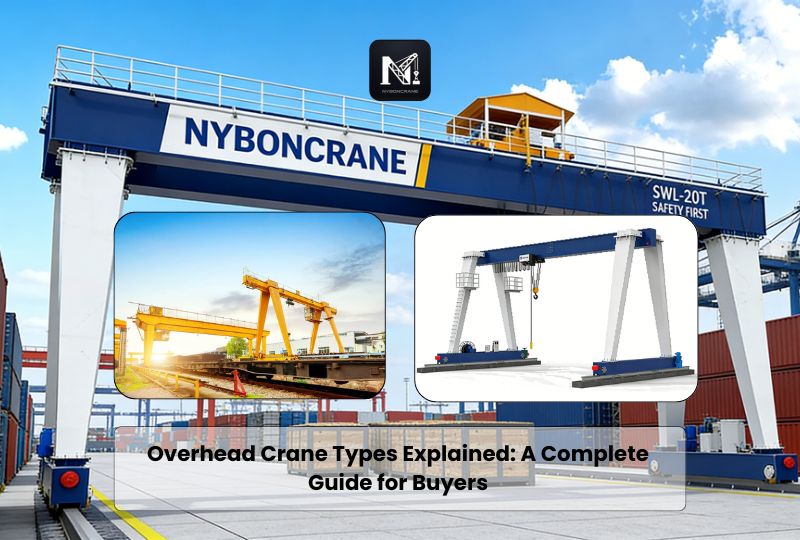
Not every facility has the structural steel needed to support a runway-mounted crane, and that is where gantry cranes come in. A gantry crane uses its own A-frame legs to support the bridge and hoist, so it does not rely on the building at all. This makes it a practical option for outdoor yards, shipyards, precast concrete plants, and any site where installing overhead runways would be too costly.
Within the gantry family, a few configurations are worth knowing:
- Single girder and double girder gantry cranes follow the same capacity logic as their overhead crane counterparts, just supported on legs instead of runway beams.
- Rubber-tyred gantry (RTG) cranes run on rubber tires rather than rails, giving them the mobility needed in container yards and ports for stacking and repositioning containers.
- Semi-gantry cranes have one leg supported by the building structure and the other resting on the ground, a hybrid solution for sites with partial structural support.
- Portable and adjustable gantry cranes are smaller, wheel-mounted units used in maintenance shops and tight spaces where a permanent structure is not needed.
Jib Cranes
A jib crane looks like an upside-down L, with a horizontal arm that swings from a fixed vertical mast or a wall-mounted pivot. It covers a smaller circular or semicircular area compared to a bridge crane, but it is fast to install, low cost, and ideal for repetitive lifting at a single workstation, loading dock, or machine tool. Wall-mounted jib cranes save floor space entirely by anchoring to a building column, while freestanding jib cranes work anywhere a fixed base can be poured.
Monorail Cranes
A monorail crane runs a hoist and trolley along a single fixed I-beam track, following a set path rather than covering an open area. This makes it especially efficient on production and assembly lines, where materials move repeatedly between the same points. Monorail tracks can be straight, curved, or built with switches to move loads between multiple lines, giving more flexibility than the name might suggest.
Workstation Cranes
Workstation cranes are lightweight, modular systems, often aluminum, designed to support a single work cell or a small team performing frequent, lighter lifts. They are common in electronics assembly, tool rooms, and packaging lines where ergonomics and speed matter more than raw capacity.
Specialized and Industrial Overhead Cranes
Beyond the standard configurations, several specialized overhead crane types are engineered for demanding or hazardous environments.
- Explosion-proof overhead cranes are built with spark-resistant components and sealed electrical systems for use in chemical plants, oil and gas facilities, and grain handling, where flammable dust or vapor is present.
- Metallurgical and casting cranes handle molten metal in steel mills and foundries, built to withstand extreme heat and often equipped with redundant safety systems given the risk involved.
- Foundry overhead cranes are a close relative, purpose-built for pouring, ladling, and pit work inside foundries. They combine heat-resistant components, slow and precise lowering speeds, and reinforced hooks to move molten metal and heavy castings safely through the production process.
- Grab overhead cranes use a mechanical grab bucket instead of a standard hook, opening and closing to pick up loose bulk materials such as scrap metal, coal, ore, or aggregates. They are common in scrap yards, power plants, and bulk material handling facilities.
- Magnet cranes use an electromagnetic lifting attachment to move ferrous materials like steel plates, beams, and scrap.
These specialized cranes are typically built to order, since the operating environment, load type, and safety requirements vary significantly from one facility to the next.
How to Choose the Right Overhead Crane Type
Picking the correct crane comes down to a handful of practical factors:
Lifting capacity and span. Match the crane’s rated load and bridge span to your heaviest and widest lifting requirement, with some margin for future needs.
Building structure. If your facility already has strong columns and runway beams, a top-running bridge crane makes sense. If not, a gantry crane avoids costly structural upgrades.
Duty cycle. Occasional lifts can be handled by lighter single-girder or workstation cranes, while continuous, high-frequency operations need a heavier-duty classification, often referenced against CMAA or FEM duty class standards.
Environment. Outdoor use, extreme temperatures, or hazardous atmospheres call for specialized designs such as explosion-proof or weather-resistant cranes.
Control system. Pendant controls suit simple, low-traffic operations, while radio remote or fully automated controls improve safety and efficiency in busier facilities.
Working through these factors, ideally with an experienced crane manufacturer, helps narrow down the right type before committing to a design and quotation.
Nybon Machinery manufactures single-girder, double-girder, and specialized industrial overhead cranes with capacities from 1 to 320 tons, custom-engineered for manufacturing, steel, and heavy industry applications worldwide.
Frequently Asked Questions
What is the most common type of overhead crane?
Single-girder and double-girder top-running bridge cranes are the most widely used, since they cover the broadest range of industrial lifting needs.
What is the difference between an overhead crane and a gantry crane?
An overhead crane relies on the building’s runway structure for support, while a gantry crane stands on its own legs and does not need overhead structural support.
Which overhead crane type is best for a small workshop?
A jib crane or workstation crane is usually the most practical choice for a single work area, offering fast overhead crane installation and a smaller footprint than a full bridge crane.