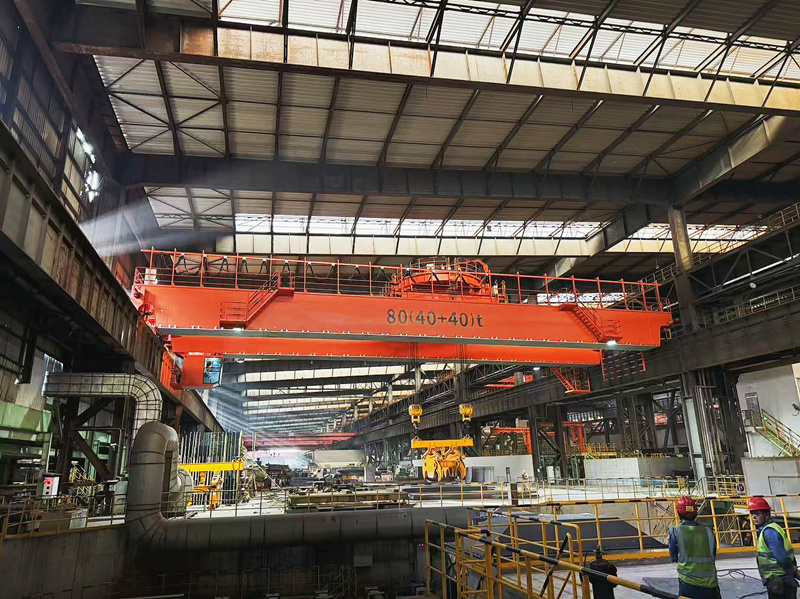
A foundry overhead crane lifts and moves ladles of molten metal inside a casting plant. It carries a much higher safety burden than a general workshop crane, because a dropped or tipped ladle can injure people and stop production. Foundries that pour at scale often choose a purpose-built casting crane for this job.
This guide covers the main features, the standards behind them, and a simple checklist for buyers.
What Makes a Foundry Crane Different
Three conditions set a foundry apart: heat, splash risk, and repeated heavy cycles. Radiant heat from the furnace and the ladle warms the girders and cables. Metal splash can hit ropes and hooks. And the same lift repeats many times each shift.
A foundry crane is designed around these conditions from the start. It is not a general crane with a few shields added.
Core Safety Features
- Two hoisting brakes. For molten metal, two independent brakes on the hoist are a common safety rule, so the ladle stays held if one fails.
- Heat shields. Plates under the girder and around the hook block shield the machine from radiant heat.
- Heat resistant wire rope. A steel core rope handles heat better than a fibre core.
- Heat resistant cables and electrics. Special insulation and screens protect the wiring.
- Overload limiter and limit switches. They prevent over lifting and over travel with a full ladle.
- Smooth speed control. A frequency converter gives gentle starts and stops, which limits ladle sway and slag spill.
Main Hook and Auxiliary Hook
Most foundry cranes carry two hooks. The main hook lifts the ladle through a ladle hanger or lifting beam. The auxiliary hook handles tilting for pouring, as well as lighter jobs such as mould parts and tools.
Duty Class and Standards
Busy melt shops lift often, and the loads are heavy. Under GB/T 3811 the duty class for ladle cranes commonly sits in the upper range of the A1 to A8 scale, such as A6 or above. Smaller foundries with fewer pours may fit a lower class. GB 6067 sets the safety rules, including those for hot metal. Buyers who use FEM 1.001 can match the class to a FEM group.
Choose the class from your pour schedule, not only from the ladle weight.
Daily Care in a High Heat Bay
- Inspect ropes after each shift, since heat and splash wear them quickly
- Keep slag and dust off rails, wheels and electrical boxes
- Check brake pads, hook wear and other hoist components on a set schedule
- Train operators in ladle handling and emergency stops
How to Choose a Foundry Overhead Crane
- Ladle weight, including the molten metal and the hanger
- Span, hook height and bay length
- Pour cycles per hour and shifts per day
- Distance between the furnace, the pouring station and the mould line
- Heat level at girder height
- Whether tilting for pouring is required
Nybon Machinery builds double girder overhead cranes for smelting and foundry workshops, with heat protection set for your bay. Share your ladle data on the contact page to start a review.
Plants that also handle scrap and bulk stock usually add a grab overhead crane in the neighboring bay.
FAQs
What is a foundry overhead crane?
It is an overhead crane built to carry ladles of molten metal in a casting plant, with heat protection and extra safety systems.
Why does a foundry crane need two hoist brakes?
Two brakes give a backup. If one fails, the second still holds the ladle, which prevents a spill.
What duty class does a foundry crane need?
It depends on pours per shift. Busy melt shops often need a high class such as A6 or above, while smaller shops can use a lower one.
How is a foundry crane different from a standard overhead crane?
It adds heat shields, heat resistant ropes and cables, dual brakes and finer speed control for molten metal handling.