Heavy material handling is one of the most demanding parts of running an industrial facility. Whether you manufacture steel components, run a warehouse, assemble machinery, or process raw materials, moving heavy loads safely and efficiently has a direct effect on productivity and cost.
So what is an overhead crane, exactly? It’s a lifting system that moves loads horizontally and vertically above a workspace, using a bridge that travels along elevated runway beams instead of ground-level rails. Because it operates overhead rather than on the floor, it keeps the workspace clear for production, personnel, and vehicle traffic.
As an experienced overhead crane manufacturer in China, we will cover how overhead cranes work, their main components, the different types available, typical applications, safety standards, and what to consider before buying one.
What Is an Overhead Crane?
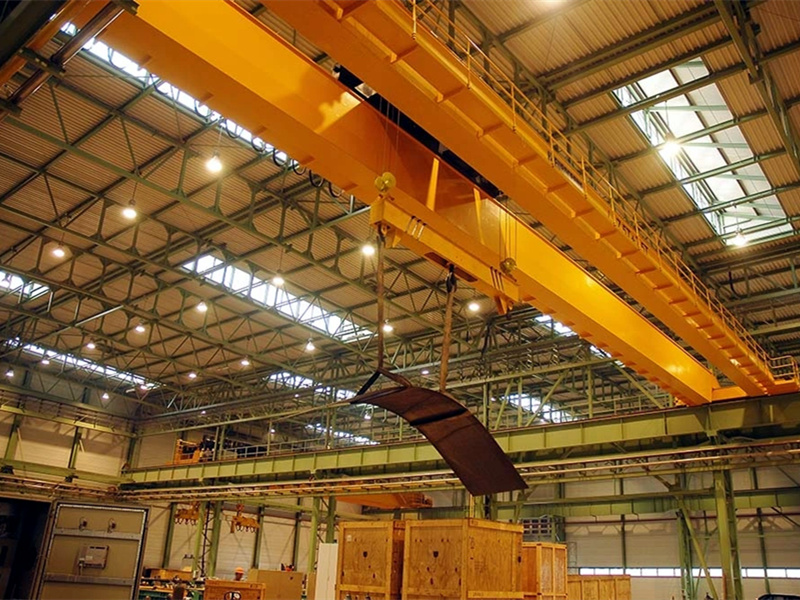
An overhead crane consists of a bridge, a trolley, a hoist, a runway system, and a set of controls. The bridge spans the work area and travels along runway beams mounted near the ceiling or on elevated support columns. The trolley rides along the bridge, and the hoist, mounted on the trolley, does the actual lifting and lowering.
Because the crane operates above the floor rather than on it, it can move loads to almost any point within its coverage area without competing for space with forklifts, workers, or production equipment. Capacities range from a few hundred pounds for light assembly works up to several hundred tons for heavy steel and shipbuilding operations.
This design is why overhead cranes are also referred to as bridge cranes or, in some regions, EOT cranes (Electric Overhead Traveling cranes). All three terms generally describe the same type of system, just with regional naming preferences.
How an Overhead Crane Works
An overhead crane moves loads using three coordinated motions:
Vertical Movement
The hoist lifts and lowers loads.
Cross Travel
The trolley moves across the bridge.
Long Travel
The bridge moves along runway beams.
Together, these three motions let an operator position a load almost anywhere within the crane’s working envelope. Cranes can be operated through pendant controls, radio remotes, an operator’s cabin, or, in more automated facilities, through programmable controls that handle repetitive lifting cycles with minimal operator input.
In a typical production setting, the crane picks up raw material at one end of the facility, moves it to a processing or assembly station, then transports the finished product toward shipping. This removes multiple manual handling steps and keeps material moving without tying up floor-level equipment.
Main Components of an Overhead Crane
| Component | Function |
|---|---|
| Bridge | The horizontal beam or beams that span the work area |
| Trolley | Carries the hoist and travels across the bridge |
| Hoist | Performs the lifting and lowering |
| Runway | Elevated beams that support and guide the bridge |
| End trucks | Connect the bridge to the runway and carry the drive wheels |
| Controls | Pendant, remote, cabin, or automated systems that operate the crane |
Component quality has a direct effect on duty life. A crane built to a recognized duty classification, such as those defined under CMAA or FEM standards, will hold up far better under continuous industrial use than a lighter-duty unit pushed beyond its intended cycle rate.
Types of Overhead Cranes
The right type depends on lifting capacity, span, building structure, and how often the crane will run.
Single girder overhead crane: Uses one bridge beam, which keeps acquisition cost, weight, and installation complexity lower. It’s a common choice for warehouses, workshops, and light-to-medium manufacturing where headroom or budget is limited. See our single girder overhead crane page for capacity and span options.
A double girder overhead crane uses two bridge beams, which allows for higher capacities, greater lifting height, and better performance under continuous heavy-duty cycles. Steel mills and large manufacturing plants typically specify double girder systems. Details are on our double girder overhead crane page.
Top running vs. under running cranes: Top running cranes travel on rails mounted above the runway beams and generally support larger capacities and longer spans. Under running cranes are suspended beneath the runway beams instead, which works well in buildings where structural limitations rule out a top-mounted rail system.
Industrial and automated systems: Facilities running high-cycle or safety-sensitive operations often add automation such as load monitoring, anti-sway control, remote diagnostics, and variable frequency drives. Our industrial overhead crane page covers configurations built for continuous-duty environments.
Overhead Crane vs. Gantry Crane
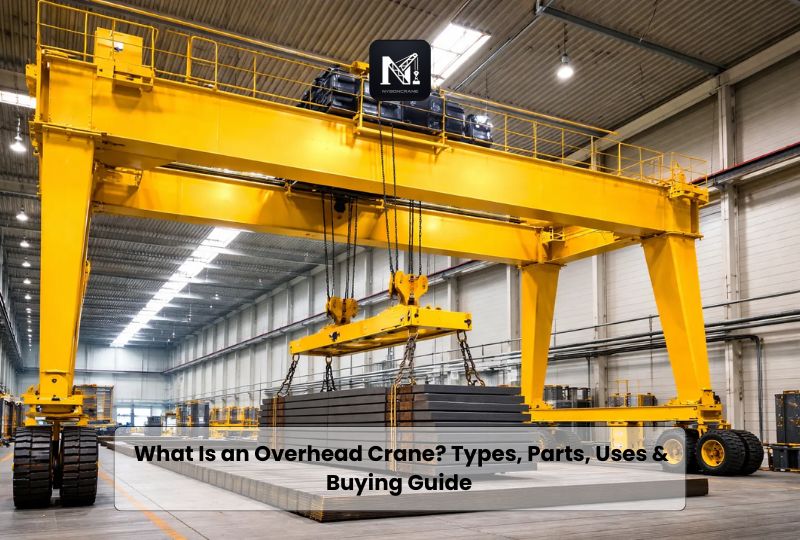
Overhead cranes and gantry cranes both move loads on a bridge and trolley system, but they’re supported differently. An overhead crane runs on runway beams mounted to the building structure, which keeps the entire floor clear. A gantry crane runs on its own legs, either on rails or wheels at ground level, which makes it a better fit for outdoor use, shipyards, and sites without a building structure to mount runway beams on.
If your operation needs floor-level mobility or outdoor coverage rather than building-mounted runways, our gantry crane range, including single girder, double girder, and rubber tyred configurations, may be a better fit. We’ve also put together a full breakdown in Gantry Crane vs. Overhead Crane
Industries and Applications of Overhead Bridge Cranes
Overhead cranes are used wherever heavy, repetitive lifting is part of daily operations:
- Steel production – moving coils, beams, plates, and structural components
- Automotive manufacturing – handling engines, chassis, molds, and large assemblies
- Aerospace – precision lifting of large airframe and structural components
- Warehousing and logistics – inventory handling, loading, and storage optimization
- Energy – equipment installation and maintenance in power generation facilities
- Shipbuilding and heavy fabrication – handling components that exceed standard forklift capacity
In warehouses specifically, moving heavy inventory overhead frees up floor space that would otherwise be used for transport aisles, reduces forklift congestion, and cuts down on manual handling risk. In manufacturing, cranes support raw material transport, assembly line feeding, tooling changes, and maintenance work, all tasks where downtime is expensive and material flow needs to stay consistent.
Overhead Crane Uses in Warehouses
Warehouses continue to be major users of overhead crane technology. Common overhead crane uses in warehouse environments include:
- Inventory handling
- Equipment loading
- Material storage
- Product movement
- Shipping preparation
The growing demand for e-commerce fulfillment centers has increased interest in efficient lifting systems throughout China.
The significant overhead crane benefits for warehouses include:
- Better storage utilization
- Reduced forklift traffic
- Faster material movement
- Improved safety
- Lower labor costs
These advantages help warehouse operators improve operational efficiency while reducing overhead expenses.
Overhead Crane Applications in Manufacturing
One of the largest markets for cranes involves overhead crane applications in manufacturing. Manufacturers depend on reliable lifting systems to support production activities.
Common applications include:
- Steel fabrication
- Machinery manufacturing
- Automotive assembly
- Aerospace production
- Heavy equipment manufacturing
- Component processing
These facilities often handle materials weighing several tons, making overhead cranes an essential part of daily operations.
Safety Requirements and Standards for Overhead Cranes
Overhead crane safety is governed by a combination of regulatory and industry standards, including OSHA 1910.179 in the United States and ASME B30.2 for design, inspection, and operation requirements. Internationally, CMAA duty classifications and FEM standards are commonly referenced for structural and mechanical design.
Core safety practices include:
- Operator training and certification before independent use
- Daily pre-shift inspections of hooks, wire ropes, and safety devices
- Load testing at commissioning and at scheduled intervals
- Safety devices such as overload protection, travel limit switches, anti-collision systems, and emergency stops
- Documented inspection programs covering daily, monthly, and annual checks
Facilities that follow a structured inspection and training program consistently see fewer incidents and less unplanned downtime than those that treat crane maintenance as reactive.
Advantages of Overhead Cranes
One reason companies continue investing in crane technology is the numerous advantages of overhead cranes. Unlike many traditional lifting methods, overhead cranes provide a combination of power, precision, and efficiency that can significantly improve facility performance.
Key advantages include:
Improved Space Utilization
Because cranes operate above the work area, valuable floor space remains available for equipment, personnel, and production activities.
Higher Productivity
Loads can be moved faster and more accurately than with many alternative lifting methods.
Enhanced Safety
Heavy materials are transported in a controlled manner, reducing manual handling risks.
Reduced Product Damage
Precise load control minimizes the chances of accidental impacts and material damage.
Long-Term Cost Savings
Although cranes require an initial investment, many facilities recover costs through improved productivity and lower labor requirements. These benefits explain why many businesses researching what is an overhead crane ultimately choose to install one.
Overhead Crane Design Considerations
Proper overhead crane design is critical for safety, reliability, and performance. Before selecting a crane, engineers evaluate several important factors.
Lifting Capacity
The crane must safely handle the maximum anticipated load.
Span Length
The span determines the distance between runway beams.
Lift Height
Facilities must ensure sufficient vertical clearance.
Duty Classification
Crane duty ratings determine how frequently the equipment can operate.
Building Structure
The building must be capable of supporting the crane system.
Future Expansion
Many companies choose designs that allow future upgrades and capacity increases. When evaluating what is an overhead crane, understanding design requirements helps businesses avoid costly mistakes.
How Much Weight Can an Overhead Crane Lift?
A common question from buyers is how much weight an overhead crane can lift. The answer depends on the crane type, engineering specifications, and intended application.
Typical capacities include:
- 1 ton
- 2 tons
- 5 tons
- 10 tons
- 20 tons
- 50 tons
- 100 tons
- 250 tons
- 500 tons or more
Heavy-duty steel mills and shipbuilding facilities often use cranes capable of lifting hundreds of tons. Warehouse operations generally require lower capacities but benefit from faster material movement. The correct capacity should always be determined by qualified engineers and crane specialists.
Overhead Crane Operation Best Practices
Safe and efficient overhead crane operation requires proper training and established procedures. Operators should always follow approved safety guidelines. Recommended best practices include:
- Conduct daily inspections
- Verify load weights before lifting
- Maintain clear communication
- Avoid sudden load movements
- Keep personnel clear of suspended loads
- Follow manufacturer recommendations
These procedures improve workplace safety and extend equipment lifespan. Understanding how an overhead crane operates is only part of the equation. Proper operator training remains equally important.
Overhead Crane Maintenance Guide
An effective overhead crane maintenance guide helps maximize equipment lifespan and reduce unexpected downtime. Preventive maintenance should include:
Daily Inspections
Operators should inspect:
- Hooks
- Wire ropes
- Controls
- Safety devices
Weekly Maintenance
Technicians should check:
- Lubrication points
- Fasteners
- Electrical systems
Monthly Inspections
More detailed inspections should evaluate:
- Structural integrity
- Hoist performance
- Brake systems
Annual Assessments
Comprehensive inspections verify long-term equipment condition. Regular maintenance protects investments and improves reliability.
How Do Overhead Cranes Improve Efficiency?
Many organizations researching what is an overhead crane are primarily interested in operational improvements. So, how do overhead cranes improve efficiency? The answer involves several factors.
Faster Material Movement
Materials can be transported directly between workstations.
Reduced Labor Requirements
One operator can move loads that would otherwise require multiple workers.
Improved Workflow
Production bottlenecks are minimized.
Better Space Utilization
Facilities can optimize layouts without dedicating large floor areas to material transport.
Reduced Downtime
Reliable lifting systems support continuous operations. These benefits often result in measurable productivity gains.
How Are Overhead Cranes Installed?
Many project managers ask how overhead cranes are installed before planning a crane investment. Installation typically follows a structured process.
Facility Assessment
Engineers evaluate building conditions and operational requirements.
Structural Analysis
The building structure is reviewed to ensure adequate support capacity.
Runway Installation
Runway beams and supporting structures are installed.
Crane Assembly
Major crane components are assembled and positioned.
Electrical Integration
Power and control systems are connected.
Testing and Commissioning
The crane undergoes performance and safety testing.
Operator Training
Personnel receive training before operational use. Professional installation helps ensure compliance, safety, and long-term reliability.
Industrial Overhead Crane Systems Explained
When discussing industrial overhead crane systems, it is important to recognize how technology continues to improve crane performance.
Modern cranes often include:
- Variable frequency drives
- Automated controls
- Load monitoring
- Energy-efficient motors
- Remote diagnostics
- Predictive maintenance systems
These innovations help facilities improve efficiency while reducing operating costs.
Many businesses working with Nybon Machinery choose advanced crane systems that support future operational growth.
Overhead Crane Benefits for Warehouses
Modern warehouse operations are under constant pressure to improve efficiency, reduce operating costs, and increase throughput. This is where the overhead crane benefits for warehouses become extremely valuable.
Warehouses handling large products, steel materials, machinery, construction components, and industrial inventory often find that forklifts alone cannot provide the required efficiency.
Major benefits include:
Improved Storage Capacity
Since cranes operate above the floor, warehouse layouts can be optimized for storage rather than transportation pathways.
Faster Inventory Handling
Large items can be moved quickly between storage locations and shipping areas.
Reduced Equipment Congestion
Facilities experience less traffic because cranes eliminate some reliance on forklifts.
Enhanced Workplace Safety
Workers are exposed to fewer manual handling risks.
Lower Long-Term Costs
Efficient material movement can significantly reduce labor expenses over time.
These advantages continue to drive demand for overhead crane installations throughout warehouses across the United States.
Overhead Crane Cost Factors
One of the first questions buyers ask involves overhead crane cost. The cost of an overhead crane depends on multiple variables. Important factors include:
Lifting Capacity
Higher capacities generally require stronger structural components.
Span Length
Longer spans increase material and engineering requirements.
Lift Height
Greater lifting heights often require specialized configurations.
Duty Cycle
Heavy-duty cranes designed for continuous operation typically cost more.
Automation Features
Advanced control systems can increase initial investment.
Installation Requirements
Facility modifications may affect overall project costs.
Because every application is different, obtaining a professional quotation is the best way to determine actual costs.
Helpful Tips Before Purchasing an Overhead Crane
Before investing in a crane system, consider the following recommendations:
Conduct a Facility Assessment
Understand current and future operational requirements.
Determine Maximum Load Requirements
Never underestimate lifting needs.
Evaluate Building Structure
Structural support requirements must be verified before installation.
Consider Future Expansion
Select a system capable of supporting growth.
Prioritize Safety Features
Modern safety technologies improve both protection and productivity.
Work With Experienced Suppliers
Qualified partners help avoid costly design and installation mistakes. These practical steps can significantly improve project success.
Why Businesses Trust Nybon Machinery
At Nybon Machinery, we provide lifting solutions designed for demanding industrial applications. Our team supports customers through every stage of the project lifecycle, including:
- Consultation
- Engineering design
- Manufacturing
- Installation support
- Commissioning
- After-sales service
Whether you require a standard crane or specialized custom overhead crane systems, our goal is to deliver reliable solutions that improve productivity and safety. Organizations throughout manufacturing, logistics, steel production, and warehousing trust Nybon Machinery for professional lifting equipment solutions.
The Summary
After understanding what an overhead crane is, it becomes clear why these systems remain essential across modern industries.
From manufacturing facilities and logistics centers to steel mills and warehouses, overhead cranes help organizations move materials safely, efficiently, and cost-effectively. Their ability to improve workflow, maximize floor space, and support heavy lifting operations makes them one of the most valuable forms of industrial equipment available today.
For companies exploring what an overhead crane is, the benefits go far beyond lifting capacity. Modern cranes improve productivity, strengthen workplace safety, reduce operational costs, and support long-term business growth.
Whether you need a standard overhead crane system, advanced automation, or fully custom overhead crane systems, working with experienced professionals is critical to project success.
At Nybon Machinery, we are committed to helping businesses implement reliable lifting solutions tailored to their unique operational requirements. By choosing the right crane, maintaining it properly, and following established safety practices, organizations can achieve decades of dependable performance and operational efficiency.
Frequently Asked Questions
What is an overhead crane?
An overhead crane is a lifting system with a bridge, trolley, and hoist that travels along elevated runway beams to move loads above a workspace, rather than at floor level.
What is the difference between an overhead crane and a bridge crane?
They’re generally the same thing. “Bridge crane” describes the structural design, a bridge spanning the work area, while “overhead crane” describes its operating position above the floor. The terms are used interchangeably in most industrial settings.
What is the difference between an EOT crane and an overhead crane?
EOT stands for Electric Overhead Traveling crane. It’s essentially the same equipment as an overhead crane, powered electrically, though the term is more common in certain international markets.
How much weight can an overhead crane lift?
Capacities typically range from 1 ton for light-duty applications to more than 500 tons for heavy industrial and shipbuilding use, depending on the crane’s design and duty classification.
How often should an overhead crane be inspected?
Daily operator checks, monthly structural and mechanical inspections, and a comprehensive annual inspection are standard practice under most safety programs.
Is an overhead crane better than a gantry crane?
Neither is universally better. Overhead cranes suit facilities with building structures that can support runway beams. Gantry cranes suit outdoor sites, shipyards, or facilities without adequate overhead structure, since they’re self-supporting on ground-level legs