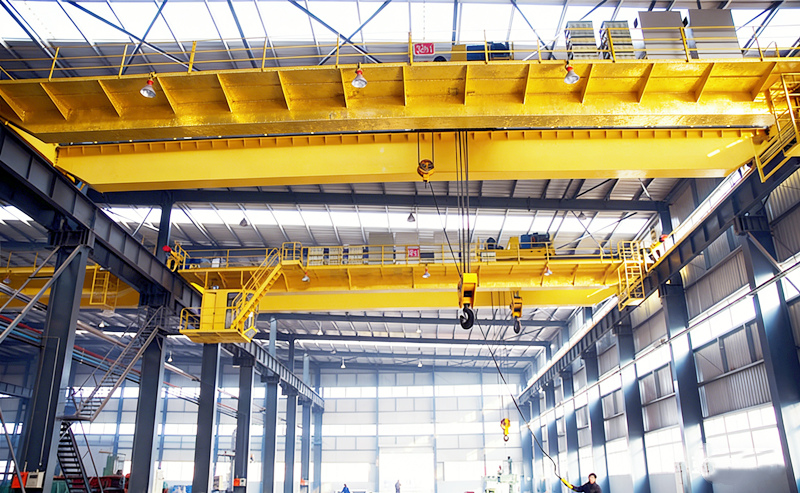
An upper trolley rotating overhead crane is a double girder crane that can turn a load while it lifts. A rotating function on the trolley or hook lets the operator change the load direction in the air, without dragging it across the floor. It is used in steel plants, where ladles, coils and heavy stock must be placed with care.
This guide explains how the design works, where it fits, and what to check before you buy.
How a Rotating Trolley Crane Works
A standard overhead crane lifts straight up and moves along two axes. It cannot turn the load. A rotating design adds a turning function, so the load can spin around the vertical hoist line.
Common set ups use these elements.
- A main trolley that carries the main hoist and the load
- A rotating unit, built into the trolley or the hook, that turns the load around the hoist line
- A second hoist or auxiliary hook, used to tilt or turn over loads that need more than a simple rotation
- A control system that keeps rotation slow and smooth
Layouts differ between suppliers and projects. Confirm the exact configuration against the loads you plan to handle.
Why Steel Plants Use This Design
Steel plants move awkward and heavy loads. A ladle may need to tilt for pouring. A long billet bundle may need to turn to fit a rack. Turning loads by hand with ropes is slow and unsafe.
With a rotating crane the operator does the turn from the control position. That cuts the number of people near the load and shortens the cycle.
- Ladle handling and tilting during pouring work
- Turning slabs, billets and long stock to fit storage racks or process lines
- Positioning equipment during mill maintenance and roll changes
- Rotating loads in tight bays where space for a swing is limited
Key Parts to Review
- Rotating mechanism. Check the gear type, the brake and the rotation speed range. Slow, damped turning protects the load and the rigging.
- Hoist and brakes. For hot metal lifting, two brakes on the hoist are a common safety rule.
- Girder and trolley frame. Rotation adds torque to the structure, so the frame must be sized for it.
- Heat protection. Shields and heat resistant cables protect the crane near molten metal.
- Limit switches and overload limiter. They guard against travel and load errors.
- Operator station. Choose a cabin with a clear view, or a remote control when the work allows it.
Duty Class and Standards
Steel plant cranes often run many cycles each shift. Under GB/T 3811, the A1 to A8 scale sets the duty class. Heavy continuous work usually sits in the upper part of that scale. GB 6067 adds the safety rules for the machine. Buyers who use FEM 1.001 can match the class to a FEM group.
Set the class from your real shift pattern, not from the load weight alone. A smaller crane that works nonstop needs a higher class than a larger crane that lifts once a day.
Related Cranes in the Same Plant
Steel plants run several overhead crane types side by side. A foundry overhead crane handles molten metal, while a grab overhead crane moves scrap and bulk material.
How to Choose an Upper Trolley Rotating Overhead Crane
Prepare this list for your supplier.
- Load weight, shape and whether it needs tilting or turning
- Rotation angle and speed you need
- Span, hook height and bay layout
- Ambient heat, dust and fumes
- Shift pattern and cycles per hour
- Maintenance access to the rotating unit
Nybon Machinery builds a double girder overhead crane platform for steel plants and can add rotation to match the load. Share your layout on the contact page for a proposal.
FAQs
What is an upper trolley rotating overhead crane?
It is a double girder overhead crane with a rotating function that turns the load around the hoist line while it is lifted.
Where is a rotating overhead crane used?
It is used mainly in steel plants for handling ladles, slabs, billets and heavy parts that need turning or tilting.
Does rotation change the crane duty class?
Not by itself. The class depends on how often and how heavily the crane works, but the rotating unit must match that class.
Is a rotating crane safer than a standard one?
It can be, because the operator turns the load from the control position and fewer workers stand near it.