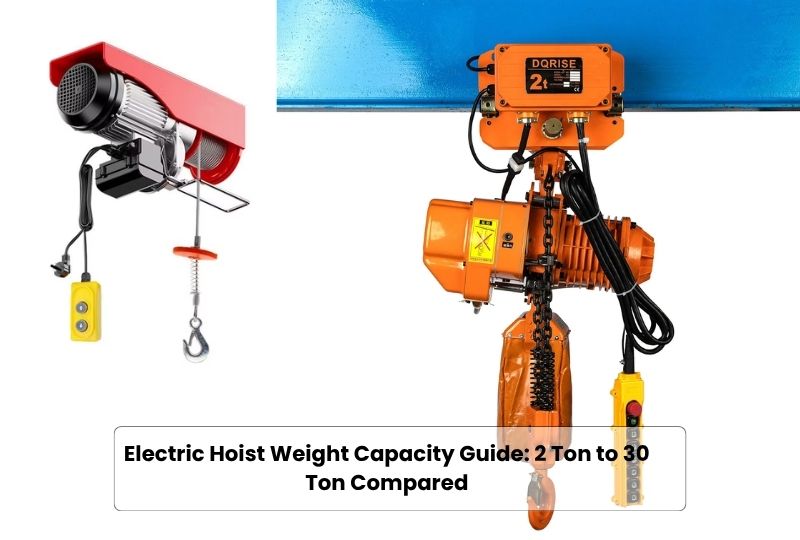
An electric hoist is only as useful as its rated capacity allows. Pick a size too small, and you risk overload, downtime, and safety violations. Pick a size too large, and you pay for motor power, structural steel, and duty class you will never use.
This guide compares electric hoists across the full working range, from a 2 ton unit suited to a small workshop up to a 30 ton hoist built for steel mills and heavy fabrication. You will see how capacity connects to motor power, duty class, lifting speed, and hoist type, so you can match a hoist to your actual load rather than guessing from a catalog page.
What Actually Determines an Electric Hoist’s Weight Capacity
Capacity is not a single number stamped on a nameplate. It comes from how several components work together.
Rope or chain strength. Wire rope hoists rely on rope diameter and construction, while chain hoists use load chain rated in grade 80 or grade 100 steel. Larger loads demand thicker rope or chain and, in many cases, more strands.
Reeving or number of falls. A single fall of rope supports the full load directly. Adding a second, third, or fourth fall of rope divides the load across multiple rope lines, which is how a compact drum can still lift heavy tonnage. Hoists above 10 tons almost always use multiple falls.
Motor power and gearbox ratio. Higher capacity needs more torque, which means larger motor kilowatt ratings and a gear reduction tuned for controlled, steady lifting rather than raw speed.
Duty or working class. Under the GB/T 3811 system used across China’s crane industry, hoists are classified from A1 to A8 based on how often they operate and how close to full load. A hoist rated A3 for occasional light use is not interchangeable with an A6 hoist built for continuous near-capacity cycles, even if both show the same tonnage on paper. FEM 1.001 (M3 to M6) is the equivalent classification many buyers outside China will recognize, and ASME-based systems use similar duty logic for the same purpose.
Safety factor. Every hoist carries a design margin between its rated working load limit and its actual breaking strength. A hoist rated for 2 tons typically has a breaking strength several times higher, which is a buffer, not extra usable capacity.
Electric Hoist Weight Capacity Chart: 2 Ton to 30 Ton
| Capacity | Common Hoist Type | Typical Motor Power | Lifting Speed | Working Class | Typical Use |
|---|---|---|---|---|---|
| 2 ton | Electric chain hoist | 1.5 to 3 kW | 4 to 8 m/min | A3 to A4 | Workshops, garages, light assembly |
| 3 to 5 ton | Chain hoist or single fall wire rope hoist | 3 to 7.5 kW | 4 to 8 m/min | A4 to A5 | General manufacturing, machine shops |
| 10 ton | Wire rope hoist (double fall) | 11 to 15 kW | 5 to 10 m/min | A5 to A6 | Heavy equipment handling, steel service centers |
| 15 to 20 ton | Wire rope hoist (multi fall) | 15 to 30 kW | 3 to 8 m/min | A6 | Shipyards, heavy fabrication, port yards |
| 25 to 30 ton | Wire rope hoist (multi fall, reinforced drum) | 30 to 45 kW | 3 to 7 m/min | A6 to A7 | Steel plants, power stations, precast concrete |
Figures vary by manufacturer, lifting height, and motor configuration, so always confirm specs against a hoist’s technical datasheet before ordering.
2 Ton Electric Hoist: Entry Point for Structured Lifting
A 2 ton electric hoist is the natural step up from manual chain blocks. It is light enough to mount on a monorail or a small single girder crane without major structural work, yet strong enough to remove manual handling risk from repetitive lifts. Most 2-ton units are electric chain hoists, since chain construction stays compact and cost-effective at this tonnage.
Typical settings include auto repair bays, small parts assembly, tool rooms, and light warehouse picking. Duty class at this level is usually A3 or A4, meaning the hoist is built for regular but not constant near-capacity cycling.
3 to 5 Ton Electric Hoist: The General Purpose Workhorse
This range covers the widest share of industrial hoist demand. A 3 to 5 ton hoist handles machine components, mold changes, palletized freight, and general production line material handling. Both chain and single fall wire rope hoists compete in this bracket, and the choice usually comes down to lift height and duty cycle rather than raw capacity.
Chain hoists remain popular up to about 5 tons because chain is simpler to maintain and less expensive per unit. Wire rope hoists start to make more sense once lift height grows or the hoist needs to run for long, uninterrupted shifts.
10 Ton Electric Hoist: Where Wire Rope Takes Over
At 10 tons, wire rope hoists become the standard choice. Chain construction at this tonnage would require excessively thick, heavy chain, so manufacturers shift to steel wire rope run through a double fall reeving system. This keeps the hoist body compact while still meeting the required breaking strength.
A 10 ton hoist commonly serves steel service centers, heavy machine shops, and facilities handling large equipment components. Working class typically rises to A5 or A6, reflecting more demanding, closer to rated capacity duty cycles.
15 to 20 Ton Electric Hoist: Built for Continuous Heavy Use
Once capacity reaches 15 to 20 tons, hoists are engineered for sustained industrial duty rather than occasional lifts. Multiple rope falls, reinforced drums, and higher horsepower motors are standard. Lifting speed often drops slightly compared to smaller hoists, since the priority shifts from speed to controlled, stable movement of heavy loads.
Shipyards, port operations, and heavy steel fabrication are typical environments. These hoists are frequently paired with double girder overhead cranes or double girder gantry cranes, since single girder structures rarely have the load path capacity this tonnage requires.
25 to 30 Ton Electric Hoist: Heavy Industry Territory
At the top of this range, electric hoists are purpose-built for steel plants, power stations, and precast concrete yards where loads are large, dense, and lifted repeatedly through the working day. Reinforced drums, upgraded braking systems, and higher duty class ratings, often A6 or above, are standard at this level.
Hoists in the 25 to 30 ton class are almost always wire rope units integrated into double-girder crane systems, since the structural steel, headroom, and rope reeving needed at this tonnage go well beyond what single-girder designs can support.
Chain Hoist vs Wire Rope Hoist Across the Weight Range
The chain versus wire rope hoist decision is less about preference and more about physics at scale.
Chain hoists dominate from fractional ton loads up through about 5 tons. Chain is durable, low maintenance, and well suited to intermittent duty. Beyond that range, chain becomes bulky and heavy relative to the load it carries.
Wire rope hoists take over from roughly 5 tons upward and remain the standard all the way to 30 tons and beyond. Wire rope allows longer lift heights, smoother positioning, and higher duty cycles, which matches the demands of heavier industrial operations. Nybon Machinery manufactures both chain and wire rope electric hoists across this full range, so buyers can standardize on one supplier as their capacity needs grow.
Why Duty Class Matters More As Capacity Increases
A common mistake is comparing hoists purely by tonnage and ignoring duty class. Two 10-ton hoists can look identical on a spec sheet, yet one built for A4 duty will wear out far faster than one built for A6 duty if both run continuous shifts. As capacity climbs into the 15 to 30 ton range, the gap between a light duty and heavy duty build widens, since components are cycling closer to their rated limit more often. Always check working class alongside tonnage, especially for any hoist that will run more than a few hours per shift.
How to Choose the Right Capacity for Your Operation
Start with the heaviest single load you will ever lift, not your average load. Add the weight of any lifting attachments, slings, or spreader beams, since the hoist must rate above this combined total, not just the product weight.
Next, factor in frequency. A hoist lifting near its rated capacity dozens of times per shift needs a higher duty class than one used a few times per day. Finally, plan for growth. If your operation is likely to scale up in the next few years, sizing slightly above current needs can avoid a costly hoist replacement later.
Frequently Asked Questions
What is the most common electric hoist capacity for industrial use?
Electric hoists between 3 and 5 tons are the most widely used in general manufacturing, since they cover the majority of machine handling, mold changing, and material movement tasks without requiring heavy structural crane support.
At what weight capacity do wire rope hoists replace chain hoists?
Wire rope hoists generally take over from chain hoists around 5 tons, since chain construction becomes too bulky and heavy to remain practical above that point.
Can a single girder crane support a 20 ton electric hoist?
Most single girder cranes are not designed for 20 ton loads. Capacities above roughly 15 to 16 tons typically require a double girder crane structure to safely distribute the load path.
Does a higher duty class mean a stronger hoist?
Not exactly. Duty class reflects how often and how close to rated capacity a hoist can operate, not how much weight it can lift. A hoist can be rated for high tonnage yet still carry a lower duty class if it is built for occasional rather than continuous use.
How do I know if I need a 30 ton electric hoist instead of two smaller units?
If your single heaviest load exceeds what a 15 to 20 ton hoist can safely handle, a 30 ton unit is the correct choice. Splitting one heavy load across two smaller hoists is generally not a safe substitute unless the system is specifically engineered for tandem lifting.