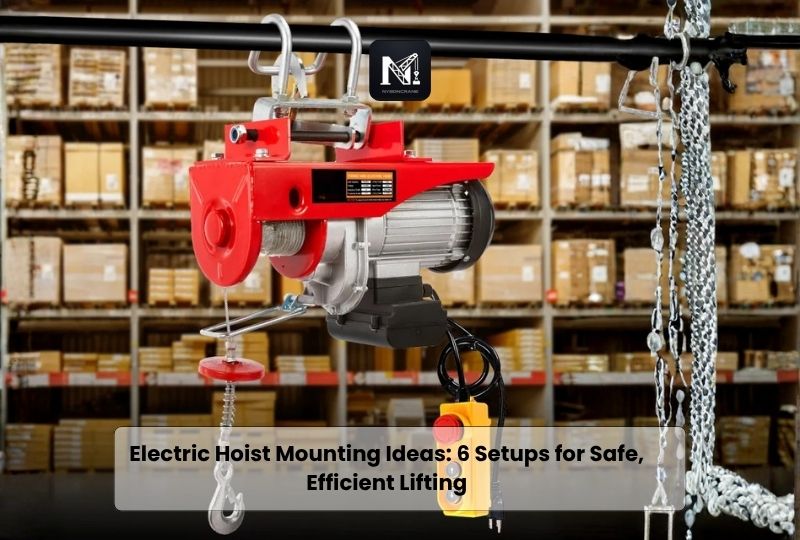
An electric hoist only performs as well as the structure it hangs from. The mounting method decides how much weight the hoist can safely handle, how far the load can travel, and how much floor space stays clear for daily work. Getting this choice right at the planning stage saves rework, downtime, and safety risk later.
Here are the most common electric hoist mounting ideas used in factories, warehouses, and workshops. Each option includes its typical use case, strengths, and what to check before installation.
1. Fixed Point Mounting (Hook or Lug Mount)
Fixed point mounting is the simplest setup. The hoist body is suspended from a single hook or bolted to a lug on a fixed beam, frame, or ceiling anchor. There is no horizontal travel. The hoist only moves loads straight up and down.
This works well for a single lifting station, such as a loading dock, a machine assembly point, or a maintenance bay where the load never needs to shift sideways. It is also the easiest and least expensive mounting method to install, since it avoids trolleys, rails, or runway beams.
Before choosing this setup, confirm that the anchor point can carry the full rated load plus the hoist’s own weight, with an appropriate safety margin. A structural engineer or the building’s original design documents should confirm this, not a visual estimate.
2. Trolley Mounting on an I-Beam or H-Beam
Trolley mounting adds horizontal movement to the lift. The hoist is attached to a trolley, either a plain push trolley or a motorized electric trolley, which runs along the bottom flange of an I-beam or H-beam. This is one of the most widely used mounting ideas in industrial settings because it combines vertical lifting with straight-line travel along a fixed path.
Electric trolleys suit high-frequency lifting where manual pushing would slow down the workflow. Push trolleys remain a lower-cost option for lighter, less frequent moves.
Two details matter most here. First, the beam’s flange width must match the trolley’s wheel spacing. Second, the beam itself, along with its supporting columns, must be rated for the combined weight of the hoist, trolley, and maximum load.
3. Monorail Mounting
A monorail setup extends the trolley concept along a longer, sometimes curved, track. Instead of a single straight beam, the hoist travels along a continuous rail system that can include curves, switches, or turntables to redirect the load between workstations.
Monorail mounting fits production lines and repetitive material flows, such as moving parts between machining, painting, and assembly stations. It reduces manual handling over longer distances and keeps the lifting path fixed and predictable, which improves both safety and repeatability.
Monorail installation is more involved than a single beam trolley and usually requires a dedicated design layout matched to the plant floor.
4. Wall Mounting with a Jib Arm or Bracket
Wall-mounted hoists attach to a rotating jib arm or a fixed wall bracket instead of an overhead beam. The jib arm allows the hoist to swing through an arc, giving coverage over a defined work area without needing a full runway system.
This setup works well in tight spaces where overhead structure is limited, but a strong wall or column is available. It is common in workshops, tool rooms, and single-station work cells where the lifting area is small and well defined.
The wall or column must be checked for both vertical load and the bending force created by the jib arm’s reach. This is different from a straight vertical load calculation, so it needs its own structural review.
5. Gantry Crane Mounting
When there is no suitable overhead beam or wall to mount from, a gantry crane provides an independent support structure. The hoist mounts to a trolley that runs along the gantry’s main girder, while the gantry itself stands on legs and moves on wheels or fixed feet.
Gantry mounting is the practical choice for outdoor yards, loading areas, or facilities where the building structure cannot support a hoist load. Depending on the layout, gantry cranes come in single girder and double girder designs, with fixed or rubber-tyred travel for added mobility.
At Nybon Machinery, we manufacture gantry cranes across single girder, double girder, and mobile RTG configurations, built to match different span, headroom, and duty requirements for hoist mounting.
6. Double Girder Top Mounting
For heavier loads and larger spans, the hoist can sit on a trolley that runs on top of two parallel girders, rather than hanging beneath a single beam. This is known as double girder or top-running mounting.
Top mounting gives more headroom clearance under the load and supports higher capacities than single girder or underhung setups. It suits foundries, steel yards, and heavy manufacturing where both load size and lifting height are significant.
Double girder mounting requires an overhead crane structure designed for the combined weight of both girders, the trolley, the hoist, and the rated load, reviewed against the facility’s duty class.
Choosing the Right Mounting Setup
A few factors decide which mounting idea fits a given application best.
Load capacity and duty class. Chinese standards GB/T 3811 and GB 6067 classify cranes and hoists into duty groups from A1 to A8 based on how often and how heavily they are used. A hoist running near capacity for eight hours a day needs a stronger mount than one used occasionally for light loads.
Available headroom. Low ceiling spaces often call for low-headroom hoist models paired with underhung trolleys, since standard top-running designs need more vertical clearance.
Horizontal travel needs. A fixed lifting point is enough for single-station work. Trolley, monorail, or gantry mounting is needed when the load must move between areas.
Structural condition. Existing beams, walls, and columns must be verified for load capacity before any hoist is attached. This check should always come from a qualified structural assessment, not an assumption based on the building’s age or appearance.
Indoor versus outdoor use. Gantry cranes suit outdoor yards and sites without existing overhead structure, while beam and monorail mounting fit indoor facilities with suitable steelwork already in place.
Frequently Asked Questions
What is the safest way to mount an electric hoist?
The safest mounting method is the one matched to a verified structural support, correct duty class, and the hoist’s rated capacity, confirmed by a structural or engineering assessment rather than a visual check.
Can an electric hoist be mounted on any I-beam?
No, the beam’s flange width, material grade, and load rating must match the trolley and the combined hoist and load weight before mounting.
Is wall mounting suitable for heavy loads?
Wall mounting works best for light to medium loads within a jib arm’s reach, since heavier loads apply greater bending force on the wall or column and may need a gantry or overhead beam setup instead.
What mounting is best for outdoor lifting?
Gantry crane mounting is the most practical option outdoors, since it provides its own support structure without relying on existing building steelwork.
Do all hoist mounting types need a trolley?
No, fixed-point mounting on a hook or lug does not use a trolley, since it only lifts and lowers loads without horizontal movement.