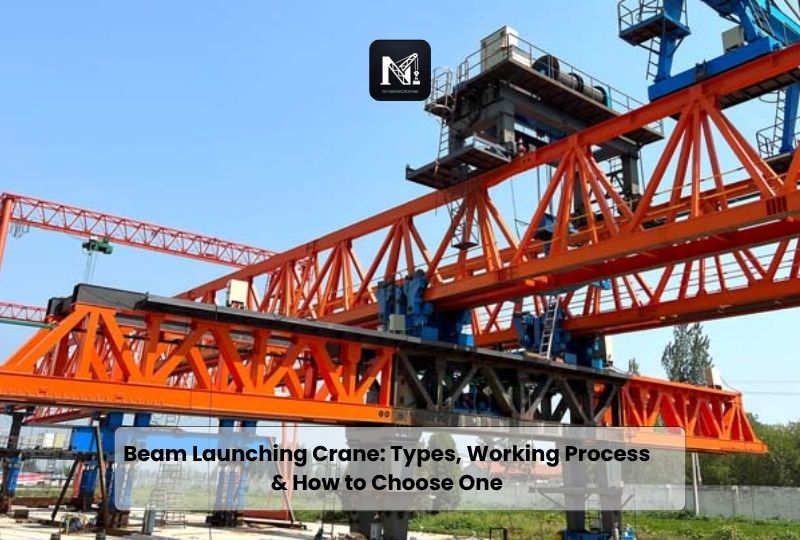
Bridge construction has moved a long way from crane after crane lifting beams from the ground. On highway, railway, and viaduct projects today, one specialized machine does almost all the heavy work of placing precast beams onto piers: the beam launching crane.
This guide covers what a beam launching crane is, how it operates, the main types used across the industry, its core components, load capacity rules, and the factors that matter when choosing one for a project.
What Is a Beam Launching Crane?
A beam launching crane, also called a launching gantry or bridge girder launcher, is purpose built lifting equipment for erecting precast concrete beams, steel girders, or bridge segments directly on the bridge structure itself. Unlike a standard crane that lifts from the ground, a beam launching crane works from the piers or the completed bridge deck, moving forward span by span as construction progresses.
Its main job is simple to describe but demanding to execute. It receives a beam from a transport vehicle or casting yard, lifts it, carries it forward along the bridge alignment, and lowers it precisely onto the bearings at the next pier. Once the span is fixed, the crane launches itself to the next position and repeats the cycle.
This is why the equipment is called a launcher. It does not just lift. It moves the entire erection operation forward along the bridge, span after span, without needing ground access underneath.
How a Beam Launching Crane Works
The working cycle of a beam launching crane generally follows these stages.
1. Positioning across two piers. The crane sets its main frame across the completed pier and the next one in line, using its front and rear support legs.
2. Receiving the beam. A beam trolley or carrier vehicle brings the precast beam from the casting yard or a truck waiting below, then transfers it to the rear of the launcher.
3. Lifting and transporting. The lifting trolleys or winches raise the beam and move it along the main girder to the correct span position.
4. Alignment and placement. Operators fine tune the beam’s position and lower it onto the bearings with millimeter level accuracy, which is essential for structural fit and long term durability.
5. Fixing and moving forward. Once the beam is secured, often with prestressing, the crane retracts its rear legs and walks or rolls forward onto the newly completed span to begin the next cycle.
This span-by-span movement is what allows continuous erection over rivers, highways, or active railway lines without disrupting traffic underneath.
Key Components of a Beam Launching Crane
Every beam launching crane, regardless of type, is built around a few core components.
- Main girder or truss. The structural backbone of the crane. Truss designs are common because they reduce wind resistance, which matters for tall piers and exposed sites.
- Front, middle, and rear legs (outriggers). These support the crane across piers and allow it to walk forward. Some designs feature adjustable or telescopic legs to accommodate different pier heights and inclined bridges.
- Lifting trolley or hoist mechanism. Handles the vertical lifting and horizontal travel of the beam along the main girder.
- Beam trolley or carrier. Transports beams from the casting yard or transport vehicle to the rear of the launcher.
- Travel and walking mechanism. Moves the crane forward once a span is complete, either on rails, wheels, or a self walking system depending on the design.
- Control system. Modern launchers use PLC control with variable frequency drives for smooth lifting and traveling, paired with cabin or wireless remote operation for precision and operator safety.
Main Types of Beam Launching Cranes
Beam launching cranes are not one size fits all. The right configuration depends on the erection method and site conditions.
Full span launching gantry. Lifts and places an entire precast span in one operation. This method works well for highway and high speed rail projects with long runs of repeated, straight spans, since it minimizes on site joining work and speeds up the schedule.
Segmental launching gantry. Used where beams or box girders are too large or heavy to precast as a full span. Segments are assembled piece by piece using either a span by span method, where all segments for one span are placed before tensioning, or a balanced cantilever method, which places segments evenly from a central pier outward. This type suits curved alignments and urban viaducts.
Overhead versus underslung launching gantry. In an overhead configuration, the beam hangs below the main truss. In an underslung configuration the truss sits below the beam. The choice usually depends on clearance requirements and beam geometry.
Guide beam type launcher. Uses a front guide beam extending ahead of the main structure to improve stability and reach during the transition between piers, useful for larger spans.
Walking type versus rail mounted launcher. Rail mounted cranes travel on rails fixed to the deck or piers, offering stable, repeatable movement. Walking type cranes use a stepping mechanism instead of rails, which suits mountainous terrain, highway reconstruction, or sites where laying rail is impractical.
Integrated transport and erection launcher. Combines beam transport and placement in a single machine, moving beams directly from casting yard to final position. This is common on projects with tight schedules and short transport distances.
Beam Launching Crane vs Traditional Crane Erection
Mobile cranes and crawler cranes can place bridge beams, but they come with real limitations on bridge projects. They need firm, level ground beneath the span, which is not always available over rivers, valleys, or active roadways. They also require repositioning for every single lift, which slows progress considerably.
A beam launching crane solves both problems. It works from the structure itself, so no ground support is needed underneath, and its self launching design lets it move to the next span quickly. On repeated span projects, this can mean several beams erected per day compared to one or two with conventional lifting methods, while also reducing the safety risks tied to heavy lifts over open ground.
Applications of Beam Launching Cranes
Beam launching cranes are used wherever precast beams or girders need to be erected efficiently and safely.
- Highway bridge construction, particularly on projects with long runs of repeated spans
- Railway and high speed rail bridge construction, where structural strength and precision are critical
- Urban overpass and viaduct construction, often requiring segmental or curved alignment capability
- Long span and cross sea bridge projects, where wind resistance and stability are major design factors
Load Capacity and Technical Considerations
Choosing the right beam launching crane starts with the numbers. The rated lifting capacity always needs to exceed the beam weight plus the lifting attachment weight, with a safety margin built in, typically around ten percent above the combined load. A crane handling an 80 ton beam with a 5 ton lifting attachment, for example, should carry a rated capacity of roughly 93 to 95 tons or more.
Span range and pier height are equally important. Standard beam launching cranes typically cover spans from about 20 to 50 meters, with lifting heights adjusted to match pier design. Heavier-duty models built for segmental or super long span work can handle significantly larger loads, though these require custom engineering.
Duty classification also matters for long term reliability. In China, cranes are rated under the GB/T 3811 and GB 6067 standards using the A1 to A8 working class system, which reflects how frequently and intensively the crane will operate. For international buyers more familiar with European standards, this generally corresponds to the FEM 1.001 classification system, which is often referenced alongside GB standards on export orders.
How to Choose the Right Beam Launching Crane
A few practical questions help narrow down the right configuration for a project.
What is the span and pier height? This determines whether a standard full span launcher or a guide beam type design is needed.
What erection method fits the bridge design? Straight, repeated spans favor full span erection, while curved alignments or oversized girders point toward segmental methods.
What is the beam material and weight? Concrete and steel beams behave differently under lift, and lifting attachments need to be matched accordingly.
What are the site conditions? Rail mounted systems work well on stable, accessible sites, while walking type launchers suit uneven terrain or reconstruction projects where laying rail is not practical.
What is the project timeline? High-volume, repeated span projects benefit most from the speed of full span erection, while complex urban sites may prioritize precision over raw speed.
Safety Features to Look For
Given the weight and height involved in beam launching operations, safety systems are not optional extras. Reliable manufacturers build in load limiters, anti sway control, emergency stop systems, and remote monitoring as standard or optional features. Wireless remote control also keeps operators at a safer distance during critical lifting and positioning stages.
Frequently Asked Questions
What is the difference between a beam launcher and a launching gantry?
The two terms are often used interchangeably, though a beam launcher typically emphasizes speed and self propelled mobility for standard beam erection, while a launching gantry crane generally refers to heavier duty equipment capable of handling larger, heavier segments with higher precision, often on curved or more complex alignments.
How much weight can a beam launching crane lift?
Most standard beam launching cranes handle loads between 50 and 200 tons, with custom builds available up to 300 tons or more for oversized segments on major bridge projects.
Can one crane handle both concrete and steel beams?
Yes, as long as the lifting attachments, such as spreader bars or clamps, are matched to the beam type. The crane’s structural capacity and control system generally stay the same across materials.
Do beam launching cranes need rails to operate?
Not always. Rail-mounted designs are common for stable, accessible sites, but walking type launchers move using a stepping mechanism instead, which suits mountainous terrain or sites where installing rail is impractical.
How long does it take to erect a bridge span with a beam launching crane?
This depends on beam size and site conditions, but a well-operated launcher can typically place several beams per day, compared to one or two with conventional ground-based lifting.
Nybon Machinery designs and manufactures beam launching cranes for highway, railway, and viaduct construction, with capacities from 50 to 200 tons and fully customizable spans and control systems. You can view detailed specifications on our beam launching crane page.