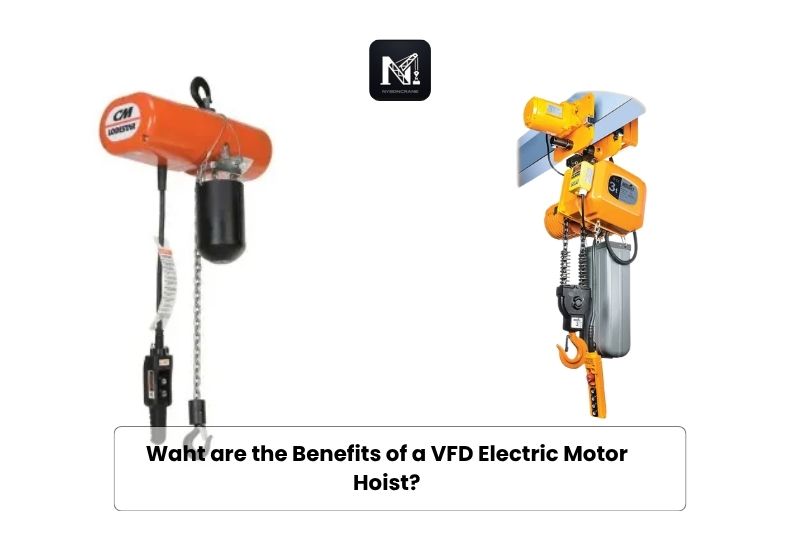
A VFD electric motor hoist is quickly becoming the standard choice for facilities that need more control, more safety, and lower long-term costs from their lifting equipment. Instead of running at a single fixed speed, a VFD hoist adjusts the frequency and voltage sent to the motor, giving the operator smooth, adjustable, precise movement on every lift. This article breaks down exactly what a VFD Electric hoist is, how it works, and the specific benefits that make it worth the investment.
What Is a VFD Electric Motor Hoist?
VFD stands for variable frequency drive. In a standard electric hoist, the motor typically runs at one or two preset speeds. A VFD hoist replaces that rigid setup with an electronic drive that continuously varies the frequency and voltage supplied to the motor. This allows the hoist to accelerate gradually, decelerate smoothly, and hold precise speeds anywhere within its range rather than jumping between fixed steps.
The result is a hoist that behaves less like an on-off switch and more like a dial, giving the operator fine control over how fast a load moves at every stage of the lift.
How VFD Technology Works in a Hoist
The VFD sits between the power supply and the hoist motor. It reads the input signal from the operator, whether that is a pendant, radio remote, or automated control system, and converts it into a matched frequency and voltage output. Lower frequency produces slower motor speed, and higher frequency produces faster motor speed.
Because this adjustment happens electronically rather than mechanically, the transition between speeds is gradual instead of abrupt. This is what creates the soft start and soft stop behavior that VFD hoists are known for, along with the ability to fine-tune positioning through micro speed adjustments.
Key Benefits of a VFD Electric Motor Hoist
Smoother Starts, Stops, and Speed Transitions
Traditional single-speed or two speed hoists tend to jerk into motion and stop abruptly. A VFD hoist ramps up and down gradually, which removes the sudden jolts that cause load swing. This soft start and soft stop behavior is one of the most noticeable differences an operator will feel the first time they use a VFD hoist.
Precise Load Positioning
Because the drive can hold the motor at almost any speed within its range, operators gain much finer control when placing loads. Many VFD hoists offer a wide speed ratio, often around 6 to 1 between the lowest and highest speed, so heavy or delicate items can be positioned exactly where they need to be without overshooting the target.
Reduced Load Swing and Better Safety
Sudden acceleration and deceleration are the main causes of pendulum swing in a suspended load. Since VFD control smooths out every speed change, load sway is significantly reduced. Some systems build on this with sway damping features that actively counteract swing, which allows operators to focus on positioning the load rather than fighting momentum.
Less Mechanical Wear and Longer Service Life
Mechanical shock from abrupt starts and stops puts stress on brakes, wire ropes, gearboxes, and structural components over time. A VFD hoist minimizes that shock, so brakes are used mainly for holding and emergency stops rather than as the primary method of decelerating the load. This lowers wear on the braking system and extends the working life of the hoist and its components.
Lower Energy Consumption
A VFD only draws the power the load actually requires at any given moment. Lighter loads consume less energy, and the drive scales output up only when a heavier load demands it. Over time, especially in facilities running hoists for many cycles per day, this translates into a measurable reduction in electricity costs compared to fixed speed motors that always draw a set amount of power.
Higher Duty Cycle Capability
Facilities with frequent, repetitive lifting cycles need equipment that can handle sustained use without overheating or excessive wear. VFD control helps manage motor load more efficiently across a duty cycle, which supports the higher classification requirements found in standards like GB/T 3811 and its A1 to A8 duty grouping. This makes VFD hoists a practical fit for operations that fall into the medium to heavy duty classes, where cycle frequency and average load are higher than light duty applications.
Lower Maintenance and Downtime
Reduced mechanical stress naturally leads to fewer unplanned repairs. Brakes last longer, wire ropes see less shock loading, and structural components experience less cumulative fatigue. For maintenance teams, this means fewer inspection flags and less unscheduled downtime, which keeps production schedules on track.
Quieter and More Controlled Operation
The gradual acceleration and deceleration of a VFD hoist also reduces the mechanical noise associated with abrupt gear engagement and braking. Operations that value a calmer, more controlled work environment, such as assembly lines or facilities with nearby personnel, benefit from this quieter performance.
Versatility Across Applications
VFD technology is not limited to one type of hoist or crane. It can be applied to single-girder overhead cranes and double girder overhead cranes, electric hoists, and gantry crane systems. This makes it a flexible upgrade path for facilities that want to standardize control technology across different pieces of lifting equipment.
VFD Hoist vs Fixed Speed and Two Speed Hoist
A fixed speed hoist offers only one operating speed, which limits control and increases the chance of sudden load movement. A two-speed hoist improves on this slightly by offering a slow and fast setting, but the jump between the two is still abrupt and offers no fine adjustment in between.
A VFD hoist removes these limitations by allowing continuous speed adjustment across its full range. Where a two-speed hoist forces the operator to choose between two fixed points, a VFD hoist lets the operator dial in exactly the speed the task requires, whether that is a slow, careful placement or a faster transport move.
Where VFD Electric Hoists Make the Biggest Difference
VFD hoists tend to deliver the most noticeable value in operations where precision, repetition, or sensitive materials are involved. This includes assembly lines that require exact positioning, facilities handling fragile or high-value goods, workshops running frequent lifting cycles throughout the day, and any application where reducing load swing is a safety priority. Heavier duty operations, such as steel handling or foundry work, also benefit from the reduced mechanical stress that VFD control provides across a demanding duty cycle.
What to Consider Before Choosing a VFD Hoist
Before selecting a VFD electric hoist, it helps to think through the actual duty cycle the equipment will face, including how many lifts per hour and how close to rated capacity those lifts typically run. Matching the hoist to the correct duty classification under GB/T 3811 avoids underspecifying equipment that will wear out faster than expected. It is also worth confirming the required speed ratio, the lifting capacity needed, and whether the application calls for additional features like sway control or synchronized multi-point lifting.
Nybon Machinery designs and manufactures VFD electric hoists as part of a wider range of overhead and gantry crane equipment, built to match duty requirements from light workshop use through heavier industrial applications.
Frequently Asked Questions
What does VFD mean in an electric hoist?
VFD stands for variable frequency drive, an electronic control system that adjusts the frequency and voltage sent to the hoist motor to produce smooth, adjustable speed control instead of a single fixed speed.
Is a VFD hoist better than a two-speed hoist?
A VFD hoist offers continuous speed adjustment across its full range, while a two-speed hoist only switches between two fixed points, so a VFD hoist provides finer control and smoother load handling.
Do VFD hoists save energy?
Yes, VFD hoists adjust power draw based on the actual load being lifted, so lighter loads consume less energy compared to a fixed speed motor that draws a constant amount of power regardless of load.
Does a VFD hoist reduce maintenance costs?
Yes, because VFD control reduces mechanical shock from abrupt starts and stops, brakes and structural components experience less wear, which lowers the frequency of repairs and unplanned downtime.
Can VFD technology be used on gantry cranes and overhead cranes as well?
Yes, VFD control is not limited to hoists alone. It is commonly applied across overhead cranes, gantry cranes, and electric hoist systems to standardize smooth, precise motion control throughout a facility.