A beam transport cart moves heavy precast beams and girders across a construction site. Our beam transport cart page lists the equipment. This guide explains how carts work, which types exist and how to choose one.
On a bridge project, the cart links the casting yard to the beam launching crane that sets each beam on the piers.
Where a Beam Transport Cart Fits
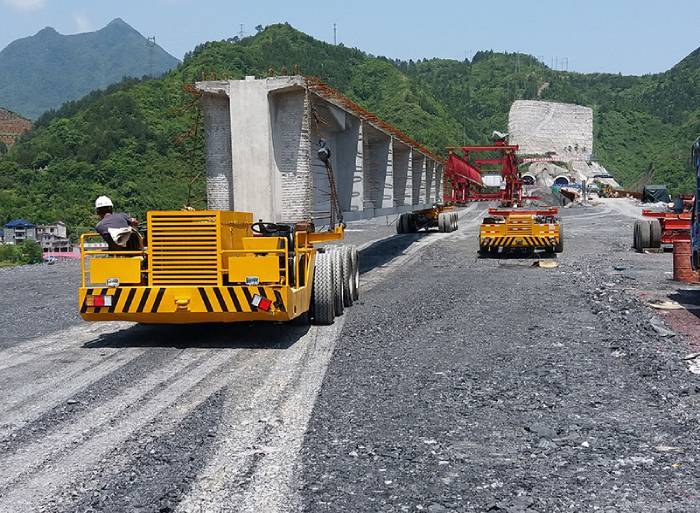
Bridge girders are cast and cured in a yard, often far from the piers. They are too long and heavy for ordinary trucks. A transport cart carries them along a rail or a prepared road to the lifting point. From there a gantry or launching crane picks the beam up.
The cart keeps the site moving. Without it, the erection crane waits for beams.
Main Types of Beam Transport Cart
- Rail guided cart: runs on tracks laid between the yard and the launching point. It is stable and predictable, and suits repeated moves along a fixed route.
- Wheeled cart with steering: moves on tyres or heavy wheels over a prepared road. It gives more route freedom but needs a firm, level surface.
- Twin cart pair: two carts support the beam at both ends, which suits long girders. The carts must move in step.
Some projects mix types. For example, rail carts inside the yard and a wheeled cart on the final approach.
Key Features to Review
- Load capacity. Add the beam weight, the support frames and a safety margin.
- Steering system. Good steering lets the cart turn on site roads without dragging the load. Precise control helps near the launching crane.
- Drive and brakes. Smooth starts and stops protect the beam from shock. A dependable brake holds the load on slopes.
- Support saddles. They must match the beam shape and protect the concrete surface.
- Stability. A wide wheel base and a low load height reduce tipping risk on uneven ground.
- Control system. Remote or cabin control with clear sight lines.
Safety Practice on Site
- Check ground bearing capacity or rail condition before every move
- Secure the beam to the cart with proper restraints
- Keep a clear route and use ground crew with signals
- Set a speed limit for loaded travel
- Inspect wheels, brakes and steering before each shift
How to Choose a Beam Transport Cart
- Beam length, weight and cross section
- Route length, slope and ground condition
- Rail or wheeled operation
- Turning space on the site
- Number of beams to move per day
- Interface with the beam launching crane or yard gantry
Nybon Machinery builds beam launching cranes and gantry cranes for engineering and infrastructure projects, so cart and crane can be matched to one workflow. Send your beam data through the contact page.
Related Gantry Equipment
Yards often use a gantry crane to lift beams onto carts. Depending on the site, that can be one of several gantry crane types, including a lightweight truss gantry crane for outdoor casting yards.
FAQs
What is a beam transport cart?
It is a heavy duty cart that carries precast beams and girders from the casting yard to the point where a crane lifts them.
Do beam transport carts run on rails?
Some do. Others use wheels with steering on a prepared road. The choice depends on route, ground and project layout.
How is a beam transport cart different from a beam launching crane?
The cart moves the beam across the site. The launching crane lifts it and places it on the piers.
What load should the cart be rated for?
Rate it for the beam weight plus supports and a safety margin. Confirm the figure with your engineer.