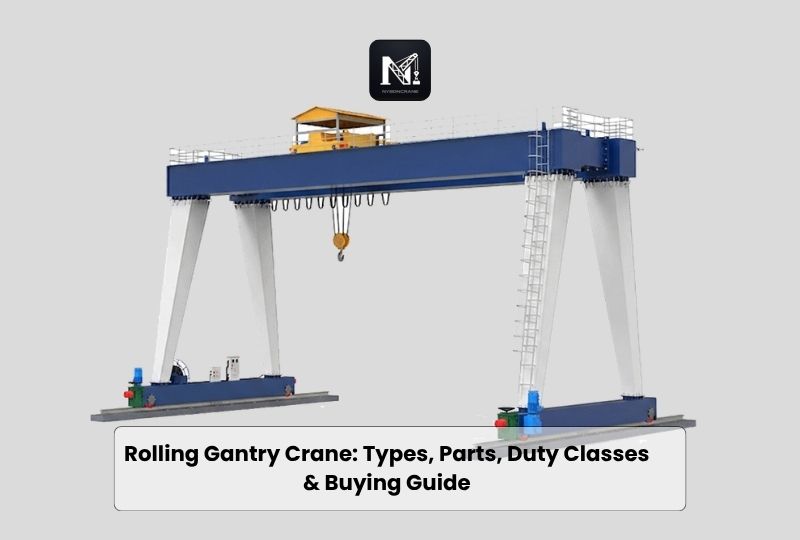
A rolling gantry crane is a gantry crane whose entire structure, including both legs, travels on wheels instead of staying fixed in one spot. The wheels run on steel rails or on rubber tyres, so the crane can move the full length of a yard, a berth, or a production line while still lifting from directly overhead. This is what separates it from an overhead bridge crane, which hangs from runway beams bolted to the building itself and never carries its own legs to the ground.
The term covers more ground than it first appears to. Single girder and double girder gantry cranes roll on steel wheels along a fixed rail. Rubber-tyred gantry cranes (RTG) roll on tyres and can shift between rows without a track at all. Rail-mounted gantry cranes (RMG) roll on rail too, but at a scale built specifically for container stacking. All four are rolling gantry cranes in the true sense of the word, and the choice between them usually comes down to ground conditions, travel pattern, and how often the crane needs to change lanes.
How a Rolling Gantry Crane Actually Moves
Every rolling gantry crane uses the same basic idea. Each leg ends in a wheel assembly called an end truck, and each end truck carries one or more flanged wheels. A travel motor and gearbox drive those wheels, and the whole assembly pushes the crane along a fixed path at a controlled speed.
On rail-mounted cranes, the wheels are flanged on both sides so they cannot ride off the track even under wind load or an off-centre lift. The rail itself sits on a concrete foundation or a runway beam, and it has to stay level and parallel within a tight tolerance, because a rail that drifts out of alignment causes the crane to skew and the wheels to wear unevenly.
Rubber-tyred gantry cranes replace the rail with large pneumatic or solid tyres, usually mounted on a steering bogie at one or both ends. This lets the crane move sideways between container rows or storage lanes without a fixed track, which is exactly why ports use RTGs for yard stacking where lane changes happen constantly.
The Main Types of Rolling Gantry Crane
Single girder rolling gantry crane. One main beam runs between two A-frame legs, and a hoist trolley travels along the bottom flange. It is the lightest and most affordable configuration, and it suits capacities up to around 20 tons for workshops, material yards, and general fabrication work.
Double girder rolling gantry crane. Two parallel girders carry a trolley that runs on top rather than underneath, which allows a lower hook approach and a much higher lifting capacity. This is the configuration most steel yards, shipbuilding berths, and heavy fabrication plants rely on when loads move past 20 or 30 tons.
Rubber-tyred gantry crane (RTG). Built for container terminals and intermodal yards, an RTG stacks containers several rows wide and several tiers high, then repositions itself between blocks without needing rail infrastructure across the whole yard.
Rail-mounted gantry crane (RMG). Where an RTG trades rail for flexibility, an RMG trades flexibility for speed and precision. Running on fixed rail through a container block gives it faster cycle times and tighter positioning, which is why terminals with high, predictable throughput often prefer RMGs over RTGs for their main stacking lanes.
Duty Class and Standards Matter More Than the Spec Sheet
A rolling gantry crane rated for 20 tons at low duty cycles will wear out fast if it is asked to run continuous, heavy operations instead. That is what duty classification is for. Under GB/T 3811 and GB 6067, cranes are graded from A1 through A8 based on how often they lift, how close to rated capacity, and how many hours they run per day. A steel yard gantry lifting near capacity for two full shifts needs a higher duty class than a workshop crane doing occasional light lifts, even if both are rated for the same tonnage on paper. Buyers working to European procurement standards will also see FEM 1.001 referenced for the same purpose, and OSHA or ASME criteria tend to appear where a project specifically calls for US or global compliance documentation.
Matching duty class to actual working pattern, not just to load capacity, is the single most common mistake in gantry crane procurement, and it is usually the difference between a crane that lasts fifteen years and one that needs major structural repair in three.
Where Rolling Gantry Cranes Are Used
Rolling gantry cranes show up wherever a yard or berth needs full overhead coverage without permanent runway steel. Shipyards use double girder rolling gantries to move hull sections and pre-assembled blocks between fabrication bays. Steel service centers and precast concrete yards use them to shift coils, beams, and panels along open storage rows. Ports and container depots rely on RTGs and RMGs to stack containers efficiently across large paved yards, and beam launching gantries, a more specialized rolling design, are used to place bridge girders during construction.
Choosing the Right Rolling Gantry Crane
Ground conditions usually decide the format first. A paved yard with room for a concrete rail foundation favors rail-mounted or standard single- and double-girder cranes, since steel wheel on rail gives lower rolling resistance and a smoother ride under heavy load. A yard that needs the crane to change lanes or work across an uneven or unpaved surface points toward rubber tyres instead.
Span and lifting height come next, and they should be set against the widest load and the tallest stack the crane will actually handle, with margin built in rather than sized to the exact current job. Travel speed matters more than buyers usually expect, since a crane that repositions too slowly becomes the bottleneck in a busy yard, while one that travels too fast for the duty cycle adds unnecessary wear on the drive system.
Duty class, as covered above, should be matched to real operating hours and load frequency rather than to the heaviest single lift the crane will ever make. And because rolling gantry cranes are structural, custom-made equipment in most cases, working with a manufacturer that engineers to the actual site rather than selling a fixed catalog spec tends to produce a crane that fits the yard instead of the other way around. Henan Nybon Machinery builds rolling gantry cranes across the single girder, double girder, RTG, and RMG range for exactly this kind of site-specific sizing, drawing on export projects across shipyards and port yards in multiple regions.
Frequently Asked Questions
What is the difference between a rolling gantry crane and a fixed gantry crane?
A rolling gantry crane travels on wheels along a rail or paved surface, while a fixed gantry crane stays anchored in one position. The rolling design lets one crane cover an entire yard or berth instead of a single fixed lifting point, which is why almost all industrial and port gantry cranes are built as rolling designs rather than stationary ones.
Can a rolling gantry crane run on rubber tyres instead of rail?
Yes, and this is exactly what a rubber-tyred gantry crane (RTG) does. It replaces steel wheels and rail with large tyres on a steering bogie, which lets the crane shift between rows or lanes without a fixed track across the whole yard, at the cost of slightly higher rolling resistance than a rail-mounted crane carrying the same load.
What duty class does a rolling gantry crane need for continuous port operation?
Continuous, high-frequency port operation typically calls for a duty class in the A6 to A8 range under GB/T 3811 and GB 6067. Lower duty classes suit occasional or light lifting in workshops and general material yards, but running a low duty class crane at port intensity shortens its structural life well below its rated design.
How wide a span can a rolling gantry crane cover?
Spans commonly range from around 10 meters for workshop-scale single-girder cranes up to 35 meters or more for heavy double-girder, RTG, and RMG designs used in ports and shipyards. The practical limit depends on required capacity, wind loading at the site, and the structural design of the girder rather than on the rolling mechanism itself.