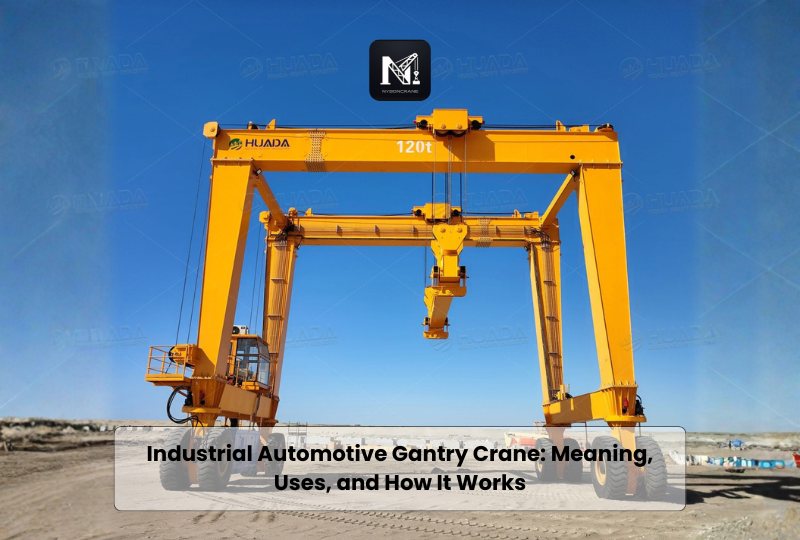
An industrial automotive gantry crane is a self-propelled, wheel-mounted gantry crane that can move under its own power across a yard, plant, or storage area without rails or a fixed foundation. In crane terminology, “automotive” does not mean it is built for the automotive manufacturing industry. It refers to the crane’s ability to drive itself, much like a vehicle, using motorized legs fitted with rubber tires or wheeled undercarriages. This is one of the most common points of confusion when researching this equipment, so it is worth clearing up before going further.
Because of this self-driving design, the term is often used interchangeably with rubber-tyred gantry crane, self-propelled gantry crane, or mobile gantry cranes in China, depending on the manufacturer and region.
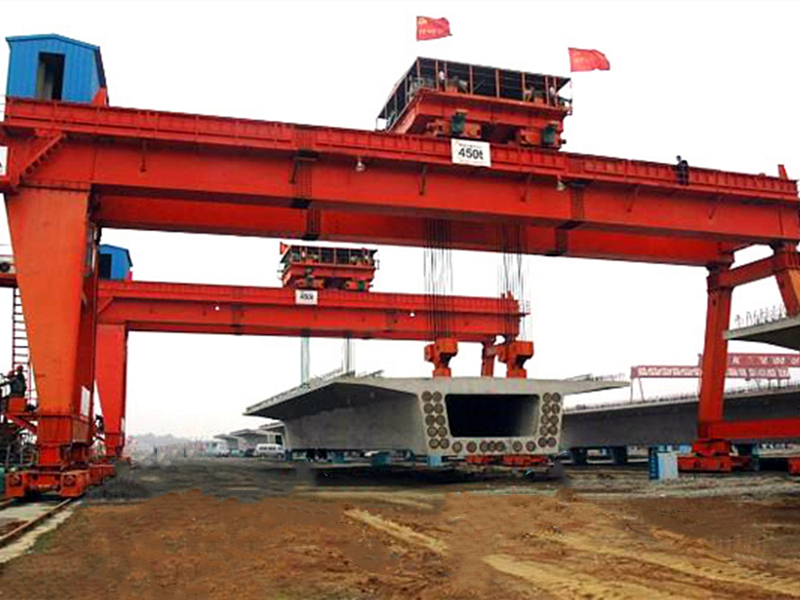
How an Industrial Automotive Gantry Crane Works
The crane consists of an elevated horizontal beam supported by two or more legs. Each leg sits on a wheeled base, and at least one set of wheels is powered, allowing the entire structure to travel across open ground without needing embedded rails.
The main working components of a gantry crane include:
Steel gantry structure: The overhead frame and legs that carry the load and give the crane its lifting span.
Hoisting mechanism: The winch, wire rope, and hook or spreader assembly that raises and lowers the load.
Trolley travel system: Allows the hoist to move side to side along the beam, positioning the load precisely.
Gantry travel system: The motorized wheels and drive units that move the entire crane forward, backward, or along a set path.
Steering and rotating legs: Many models allow the legs to pivot independently, letting the crane turn corners, move diagonally, or reposition around obstacles without a wide turning radius.
Operator cabin or remote control: Larger units are operated from an integrated cabin, while smaller or yard-based models are often remote controlled for better visibility around the load.
Power system: These cranes run on diesel generators, electric cable reels, or hybrid battery systems. Electric and hybrid versions are increasingly common because they reduce fuel costs and cut emissions in enclosed or environmentally sensitive sites.
Typical Lifting Capacity and Specifications
Capacity varies widely depending on the application. Most industrial automotive gantry cranes range explianed from around 10 tons for light yard duty up to 400 or 500 tons for heavy structural lifts. Span and lifting height are usually custom configured to match the width of the load and the clearance needed at the site, rather than sold as a single fixed size.
Industries That Rely on This Crane Type
Because it does not need rails or a poured foundation, this crane type fits industries where the working area changes often or where installing a fixed crane system is not practical.
Precast concrete production: Moving heavy concrete panels, beams, and molds between casting and curing areas.
Ports, container yards, and intermodal terminals: Stacking and repositioning shipping containers, a role where this equipment is often specifically called a rubber-tyred gantry crane.
Wind energy manufacturing: Handling turbine towers, nacelles, and blade components during assembly and staging.
Shipbuilding and heavy boilerwork: Lifting large steel sections and pressure vessel components in fabrication yards.
Steel and metal processing plants: Transporting coils, billets, and finished steel products across production floors.
Construction and infrastructure projects: Lifting bridge girders, precast segments, and oversized structural elements on active job sites.
Automotive Gantry Crane vs Fixed Gantry Crane
A fixed or rail-mounted gantry crane runs on a set track and offers very stable, repeatable movement, which suits high-volume operations in one location. An automotive gantry crane trades some of that precision for flexibility. It can relocate to a different part of the yard, work across multiple sites, or adapt to a layout that changes as a project progresses. For operations that need to move heavy loads across an open area without investing in rail infrastructure, the automotive or self-propelled design is usually the better fit.
Safety Features to Look For
Gantry crane safety on a self-propelled unit depends on more than the lifting mechanism alone. Reputable manufacturers build these cranes with overload protection, anti-collision sensors, wind speed monitoring for outdoor use, emergency stop systems, and load sway control. Since the crane itself is mobile, steering accuracy and stable braking on the drive wheels matter just as much as the hoist, since a fault in either system can put the load and the operator at risk.
Nybon Machinery designs its rubber-tyred gantry cranes around this same self-propelled principle, with configurations built for container handling, precast yards, and heavy industrial sites that need reliable mobile lifting without rail installation.
Frequently Asked Questions
Is an automotive gantry crane the same as an RTG crane?
In most cases, yes. Both terms describe a gantry crane that moves on its own wheels rather than fixed rails. RTG, or rubber-tyred gantry crane, is the more common term in ports and container handling, while automotive gantry crane is used more broadly across general industry.
Does automotive gantry crane mean it is used in car factories?
No. The name refers to the crane’s self-driving movement, not its industry of use. It can be used in ports, precast concrete plants, steel mills, and construction sites, among other settings.
What is the typical lifting capacity of this crane type?
Capacity generally ranges from about 10 tons to 500 tons, with the exact figure depending on the manufacturer and the specific application.
Can these cranes run on electric power instead of diesel?
Yes. Many manufacturers now offer electric or hybrid versions that reduce fuel costs and emissions, which is especially useful for indoor or environmentally regulated sites.
What is the main advantage over a rail-mounted gantry crane?
Mobility. An automotive gantry crane can reposition itself across a yard or between sites without the cost and time needed to install rail infrastructure.