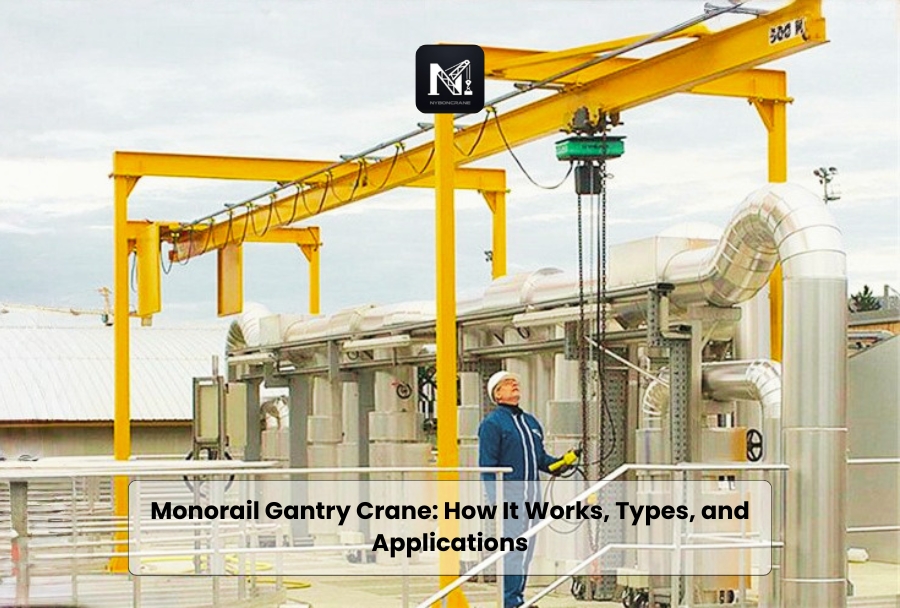
A monorail gantry crane is a lifting system that combines a ground-supported gantry frame with a fixed monorail beam running along the top. Instead of a girder that travels back and forth like a standard gantry crane, the monorail beam stays in place and a trolley with an electric hoist moves along it to carry loads from one point to another.
This design is popular in facilities that need repeatable point-to-point lifting without the cost of a full overhead runway system. It gives plants a simple way to move materials along a fixed path, especially where headroom, budget, or building structure make a bridge crane impractical.
What Is a Monorail Gantry Crane
A monorail gantry crane uses two or more vertical support legs that rest on the floor or travel on ground rails. These legs hold up a horizontal beam, and an I-beam monorail track is mounted on or integrated into that structure. An electric monorail hoist and trolley run along the track, lifting and moving loads in a straight line or along a gently curved path.
Unlike a standard single-girder or double-girder gantry crane, the monorail gantry crane does not need the entire bridge girder to travel across a runway. The hoist trolley does the moving instead, which keeps the structure lighter and often more affordable to install.
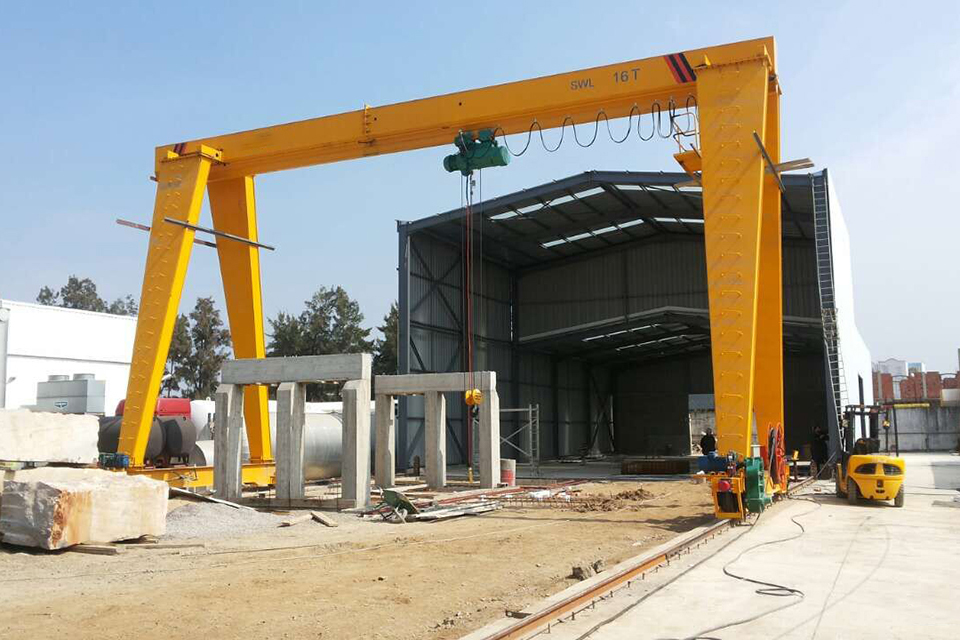
How a Monorail Gantry Crane Works
The system works on two axes of movement. The hoist raises and lowers the load vertically, and the trolley moves the load horizontally along the monorail beam. Because the beam itself is fixed to the gantry legs, there is no lateral travel across the width of a work area, unlike a bridge or double girder crane where the girder itself moves side to side.
This makes monorail gantry cranes best suited to repetitive tasks along a defined route, such as feeding a production line, moving parts between workstations, or transporting material through a coating, welding, or assembly process.
Important Components of Monorail Gantry Crane
Here are the key components of gantry cranes:
Gantry legs: Vertical steel supports that carry the full load of the structure down to the floor or ground rails. Legs can be fixed in place or designed to roll for limited repositioning.
Monorail beam: A single I beam or specially rolled section that forms the fixed track for the hoist trolley. Beam length and profile are selected based on span and load requirements.
Hoist and trolley: An electric wire rope hoist or chain hoist mounted on a trolley that rides along the lower flange of the monorail beam. The trolley can be push type, geared, or motorized depending on load size and frequency of use.
Base and rail system: For gantry cranes that travel, the legs sit on wheels running along floor-mounted rails. Fixed installations use bolted base plates anchored to a concrete foundation.
Electrical and control system: Pendant controls, remote controls, or cab controls operate the hoist and trolley. Larger systems may include variable frequency drives for smoother acceleration and load control.
Monorail Gantry Crane vs Standard Gantry Crane
A standard double-girder or single girder gantry crane moves the entire bridge girder across the span to reach different points in a work area, giving it coverage over a wide rectangular zone. A monorail gantry crane only allows movement along the length of the fixed beam, so its coverage is linear rather than area-wide.
The tradeoff is straightforward. Standard gantry cranes offer full area coverage and higher capacity, which suits heavy fabrication, container handling, and shipyard work. Monorail gantry cranes offer a simpler structure and lower cost for tasks where the load only needs to travel along one path, such as moving parts between two fixed stations.
Monorail Gantry Crane vs Overhead Monorail Crane
The two systems share the same working principle but differ in support. An overhead monorail crane hangs from the ceiling or existing building steel, which means the facility structure must be strong enough to carry the load. A monorail gantry crane is self-supporting, since its own legs carry the weight down to the floor.
This makes the gantry version a practical choice for older buildings, rented facilities, or outdoor areas where the ceiling or roof structure cannot support a hanging track.
Typical Applications of Monorail Crane
Monorail gantry cranes are common in production and assembly environments where loads move along a repeatable path. Typical uses include:
- Feeding machine tools or assembly stations in manufacturing plants
- Moving parts through painting, coating, or surface treatment lines
- Handling material in workshops without space for a full bridge crane
- Loading and unloading at fixed transfer points in warehouses
- Outdoor material transfer where building supports are not available
Because the structure is self-supporting, it also works well as temporary or semi-permanent lifting equipment in facilities that lease their space or expect to reconfigure their layout.
Safety and Design Standards
Monorail gantry cranes manufactured in China are designed and tested according to national standards rather than ASME or OSHA. The primary reference is GB/T 3811, which sets the structural, mechanical, and electrical design rules for cranes, including load calculations and steel structure requirements. Duty class ratings follow the A1 to A8 system defined in this standard, with A1 covering light, infrequent use and A8 covering continuous heavy-duty operation. Matching the correct duty class to the application ensures the beam, hoist, and support legs are sized correctly for the expected working cycles.
Routine inspection and safety devices are just as important as the initial design. Key points include:
- Regular checks on the hoist, trolley wheels, beam flanges, and end stops, since the monorail beam takes repeated point loading along its length
- Anti-drop devices and overload limiters to prevent accidental load release
- Travel limit switches and mechanical end stops on the beam to prevent overtravel
- Compliance with GB/T 3811 for structural design and GB 6067 for gantry crane safety requirements
- Third-party inspection and load testing before commissioning, as commonly required for export projects
Advantages of a Monorail Gantry Crane
Lower structural cost: Since the beam does not travel, the overall structure can be lighter than a full bridge or double girder gantry crane.
Fast, repeatable movement: The trolley follows a fixed line, which suits repetitive tasks and reduces operator decision-making.
No building modification needed: Because the crane is self-supporting, it avoids the cost and engineering review that comes with tying into a building’s roof or wall structure.
Flexible layout options: Beams can be arranged in straight runs, curves, or branching paths to match how material actually moves through a facility.
A Few Limitations to Consider
A monorail gantry crane only covers the path of its beam, so it cannot reach side to side like a standard gantry crane. It is also generally limited to lighter capacities compared to double girder or heavy-duty gantry systems built for shipyards, ports, or steel handling. For projects needing full area coverage or capacities above typical monorail limits, a single girder or double girder gantry crane is usually the better fit.
For manufacturers evaluating standard gantry crane options for heavier loads or wider coverage areas, Nybon Machinery designs single girder and double girder gantry cranes built to match specific span, capacity, and duty class requirements.
Frequently Asked Questions
What load capacity can a monorail gantry crane handle?
Most monorail gantry cranes handle loads from about 1 ton up to 20 tons, though exact limits depend on beam size, span, and duty class.
Can a monorail gantry crane be used outdoors?
Yes. Because it is self-supporting and does not rely on building steel, it can be installed outdoors on a suitable foundation or rail system.
Is a monorail gantry crane cheaper than a standard gantry crane?
In most cases, yes. The lighter beam structure and simpler trolley system usually cost less to build and install than a full girder gantry crane of similar capacity.