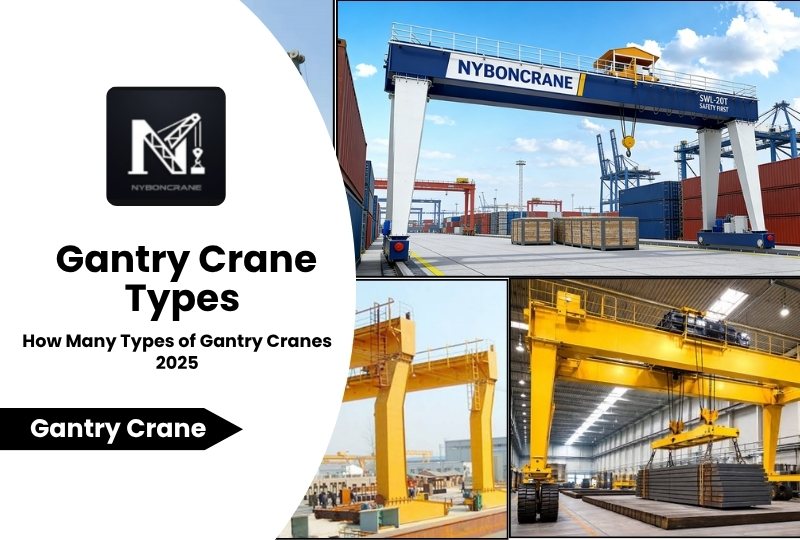
Gantry cranes are lifting machines built on freestanding legs instead of an overhead runway. The main types are single girder gantry cranes, double girder gantry cranes, rubber tyred gantry cranes (RTG), rail mounted gantry cranes (RMG), and specialized designs like straddle carriers and beam launchers. Each type is built for a specific combination of load capacity, span, and working environment. The right choice depends on your lifting capacity needs, site conditions, and how often the crane needs to move.
This guide breaks down each gantry crane type, how they differ in structure and function, and how to match a type to your application.
What Is a Gantry Crane
A gantry crane is a type of overhead crane. Instead of running along ceiling-mounted rails, it stands on its own legs, which move on wheels, rails, or tires. This makes it a strong option for facilities without the structural steel needed to support a traditional overhead crane runway. Gantry cranes are used in steel yards, shipyards, ports, precast concrete plants, and heavy fabrication shops.
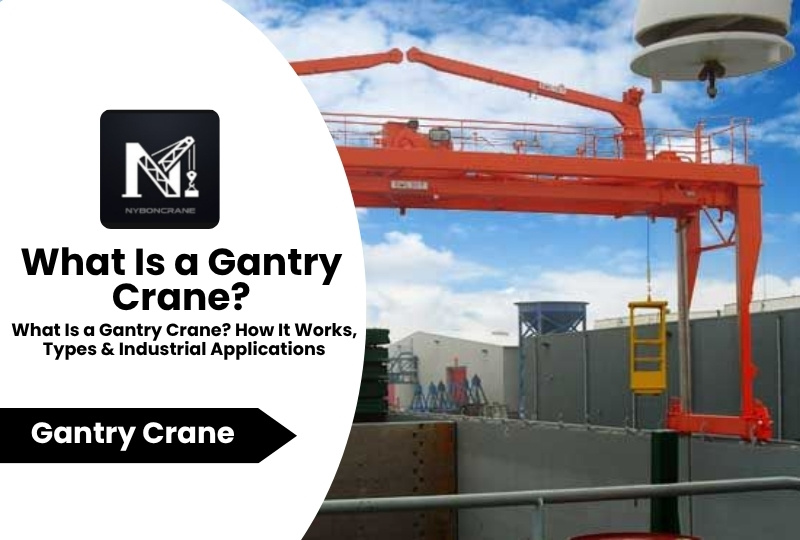
A gantry crane system has four main parts. The main girder or girders form the bridge. The legs support the bridge and carry the load to the ground. The trolley and hoist move along the girder to lift and position the load. The travel mechanism, wheels, rails, or tires, lets the whole crane move.
Gantry Crane Types by Girder Structure
Single Girder Gantry Crane
A single girder gantry crane uses one main beam supported by two legs. The hoist and trolley run along the bottom flange of the girder. This design keeps the crane lightweight and lowers material and installation costs.
Single girder gantry cranes typically handle light to medium loads, generally up to 20 tons, though capacity depends on span and duty class. They suit workshops, warehouses, and assembly lines where headroom is limited and frequent, moderate lifting is the main requirement.
Double Girder Gantry Crane
A double girder gantry crane uses two parallel main girders with the trolley running on top, between the beams. This structure supports higher lifting capacities, often 50 tons and above, and longer spans than a single girder design.
Because the trolley sits above the girders rather than below, double girder cranes also offer better hook height, which matters in tall storage yards and shipbuilding applications. They are the standard choice for steel yards, heavy fabrication, and container handling where load and span requirements exceed what a single girder crane can safely manage.
Gantry Crane Types by Girder Design
Beyond single or double girder configuration, the girder itself can be built as a box girder or a truss girder.
Box girder construction uses welded steel plates formed into a closed box section. It offers high stiffness, strong resistance to torsion, and a cleaner appearance. Box girders are the standard for medium and heavy-duty gantry cranes, especially where safety and rigidity are priorities.
Truss girder construction uses welded steel sections, similar to a bridge truss. It is lighter and more wind-resistant, which suits large outdoor spans, but has more welding points and lower rigidity than a box girder. Truss designs are more common on very large span cranes where reducing self-weight and wind load matters more than maximum stiffness.
Gantry Crane Types by Leg Configuration
The legs connecting the girder to the ground also come in different forms, most commonly A-frame and U-frame.
A-frame legs angle inward toward the top, forming a triangular shape. This is the most common configuration because it distributes load efficiently and provides strong lateral stability, though it does reduce usable width slightly at the top of the span.
U-frame legs run straight up from the ground to the girder without angling inward. This keeps the full span usable at both the top and bottom, which is useful when the full working width needs to stay consistent, such as in container yards or precast yards where equipment needs to pass directly under the full span.
A semi-gantry configuration is also worth knowing. One leg runs on a ground rail while the other side rides on an elevated runway supported by the building structure. This hybrid setup reduces the amount of ground rail needed when a facility already has partial structural support, though it is a less common configuration for heavy industrial buyers focused on full mobility and standardized capacity.
Gantry Crane Types by Mobility and Application
Rubber Tyred Gantry Crane (RTG)
A rubber tyred gantry crane runs on rubber tires instead of fixed rails, which gives it the flexibility to move between rows and reposition without needing a track system. RTGs are widely used in container terminals and ports for stacking and moving shipping containers, where operational flexibility across multiple lanes is important.
Rail Mounted Gantry Crane (RMG)
A rail-mounted gantry crane, also called a container gantry crane, runs on a fixed rail system. This gives it very precise positioning and higher lifting consistency compared to rubber-tyred designs, which makes it well suited to high-volume container yards, intermodal terminals, and rail freight hubs where containers need to be handled along a defined, repeatable path.
Straddle Carrier Crane
A straddle carrier crane is a specialized gantry style vehicle that straddles a container, lifts it internally, and transports it across a yard. It combines lifting and horizontal transport in a single unit, which reduces the number of separate handling steps in a container terminal.
Beam Launching Crane
A beam launching crane is a highly specialized gantry crane used to lift and place precast concrete girders during bridge construction. It moves along the span being built, placing one beam at a time. This type requires precise load control, stable travel mechanisms, and strong structural design given the scale and safety requirements of bridge work.
Duty Class and Working Conditions
Beyond structure and mobility, gantry cranes are also classified by working duty class, following FEM, ISO, or CMAA standards, ranging roughly from A3 to A8. This classification reflects how often the crane lifts near full capacity and how many operating cycles it needs to handle over its service life. A crane running continuous, heavy operations in a steel yard needs a higher duty class than one used occasionally in a small workshop. Features like VFD controls, anti-sway systems, and reinforced end trucks are often added on higher duty class cranes to improve precision and reduce wear.
How to Choose the Right Gantry Crane Type
Selecting a gantry crane type comes down to a few core factors.
Lifting capacity and span determine whether a single girder or double girder structure fits the job. Site conditions determine whether rail-mounted, rubber-tyred, or fixed leg designs make more sense. The application determines whether a general-purpose gantry crane is sufficient or whether a specialized type, such as a straddle carrier or beam launcher, is needed. Duty class and cycle frequency determine how robust the gantry crane’s structure and components must be for long-term reliability.
Nybon Machinery designs and manufactures gantry cranes in China, covering single girder, double girder, rubber tyred, and rail-mounted configurations for industrial and port applications worldwide. If you are comparing gantry crane types for a specific project, our team can help match a configuration to your load, span, and site requirements.
Frequently Asked Questions
What is the most common type of gantry crane?
Single girder and double girder gantry cranes are the most common types. Single girder designs handle lighter loads at lower cost, while double girder designs handle heavier loads and longer spans.
What is the difference between RTG and RMG cranes?
An RTG runs on rubber tires and can move between rows without fixed tracks. An RMG runs on a fixed rail system, offering more precise, repeatable positioning. RTGs offer more flexibility; RMGs offer more consistency.
Bridge Crane vs Gantry Crane: What’s the difference?
A gantry crane stands on its own legs and moves on wheels, rails, or tires. A bridge crane, also called an overhead crane, runs on a runway system supported by the building structure. Gantry cranes are used when a facility lacks the structural support for a runway.
What is a box girder versus a truss girder gantry crane?
A box girder is a welded steel plate structure with high stiffness, used for medium- and heavy-duty cranes. A truss girder is a lighter, welded frame structure used for large spans where reducing weight and wind resistance matters more than maximum rigidity.
What duty class does a gantry crane need?
Duty class depends on how often the crane lifts near full capacity and how many cycles it runs per day. Light workshop use typically needs a lower duty class, such as A3 or A4, while continuous port or steel yard operations need a higher duty class, such as A6 to A8.
What are foldable aluminum gantry cranes?
A foldable aluminum gantry crane is a portable lifting frame made from aluminum, with hinged legs and beam joints that let it collapse for storage or transport and unfold into a stable structure when needed. It typically handles loads from 500 kg up to a few tons and is used where lifting equipment needs to move between sites easily.