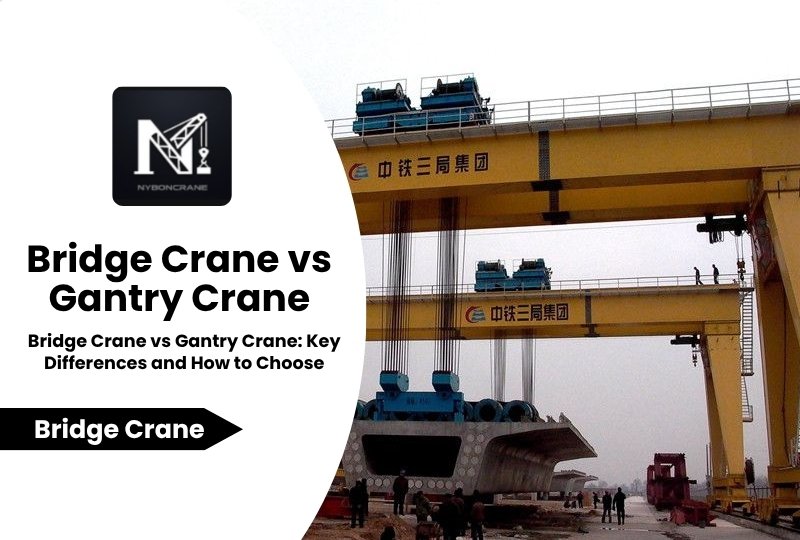
Bridge cranes and gantry cranes are two of the most common types of overhead lifting equipment used in factories, warehouses, ports, and construction sites. Both rely on a horizontal girder and a trolley-mounted hoist to move loads across a work area. But their support structure, mounting method, and ideal use cases are quite different.
Choosing the wrong crane type can lead to wasted floor space, higher installation costs, or limited lifting capacity. Let’s break down what the difference is between a bridge crane and gantry crane, so you can pick the right lifting solution for your operation.
What Is a Bridge Crane
A bridge crane, also called an overhead crane or overhead traveling crane, consists of a bridge girder that runs along two parallel runway rails. These rails are mounted to the building structure, either on wall brackets or on elevated support columns. The bridge itself carries a trolley and hoist, which move side to side along the girder while the entire bridge travels the length of the runway.
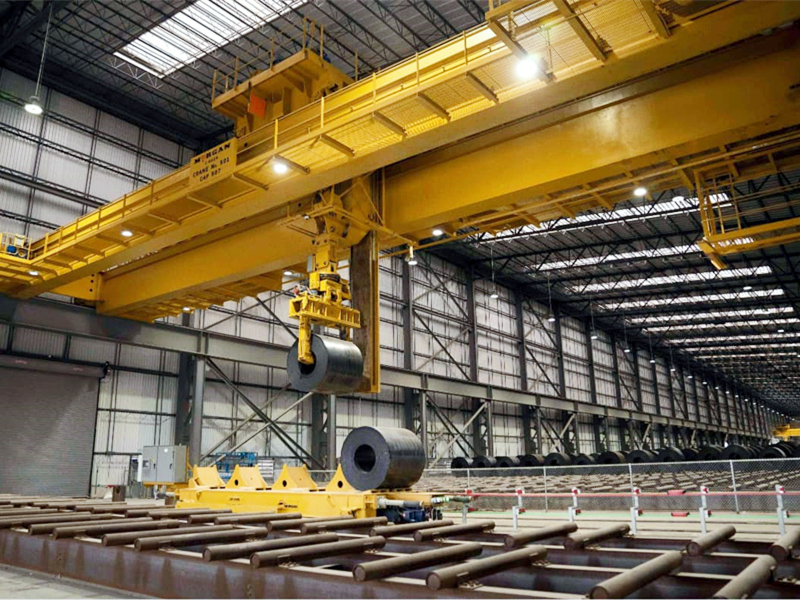
Because a bridge crane is fixed to the building, it does not take up any usable floor space. This makes it a strong choice for indoor facilities such as manufacturing workshops, assembly plants, and warehouses where floor space is limited. Bridge cranes are available in single girder and double girder configurations, with lifting capacities that typically range from half a ton to over 100 tons for heavy-duty industrial use.
What Is a Gantry Crane
A gantry crane works on a similar principle, but instead of runway rails mounted to the building, the girder is supported by vertical legs that rest on the ground. These legs may be fitted with wheels or casters for mobility, or they may run along a fixed track. Some gantry cranes use a single leg design, known as a semi-gantry crane, which combines a floor-mounted leg on one side with a runway rail on the other.
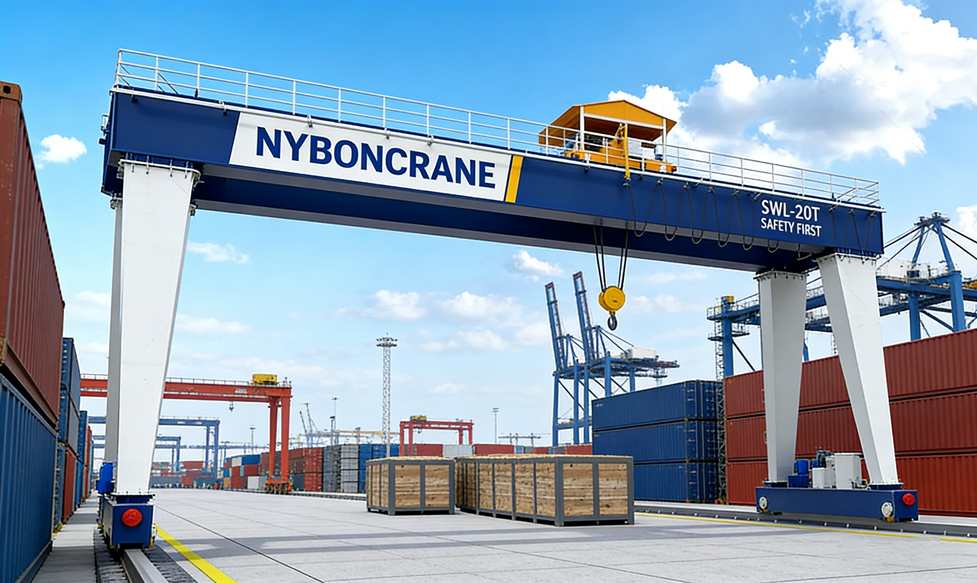
Because gantry cranes are freestanding, they do not require permanent structural support from a building. This makes them well suited to outdoor environments such as shipyards, ports, rail yards, and construction sites. Gantry cranes also handle heavy and oversized loads efficiently, including containers, steel coils, and precast concrete sections.
Related Reading: Gantry Crane Types
Key Differences Between Bridge Cranes and Gantry Cranes
Structure and Mounting
The main structural difference comes down to support. A bridge crane relies on runway rails fixed to the building’s columns or walls. A gantry crane relies on its own legs, which stand directly on the ground. This is the single biggest factor that separates the two crane types.
Mobility and Portability
Bridge cranes are permanent installations. Once the runway is fixed, the crane cannot be relocated without significant construction work. Gantry cranes, on the other hand, offer much greater portability. Wheeled or track-mounted legs allow the crane to be moved within a facility or even disassembled and reinstalled at a new site.
Application and Environment
Bridge cranes perform best in indoor settings where the workspace is fixed and repetitive, such as factory production lines and warehouse storage areas. Gantry cranes are more commonly used outdoors, in environments like ports, shipyards, and open storage yards where floor-mounted structures are impractical.
Lifting Capacity and Span
Both crane types can be engineered for heavy lifting, but gantry cranes are often preferred for very large spans and oversized loads, particularly in port and shipbuilding applications. Bridge cranes tend to offer higher precision and faster cycle times for repetitive indoor tasks, since the entire bridge does not need to be moved to reach a new location.
Cost
Bridge cranes generally involve higher installation costs because they require a reinforced building structure to support the runway rails. Gantry cranes are usually more cost-effective to install, since they do not depend on the building for support. However, total cost depends heavily on capacity, span, and site conditions.
Power Supply
Bridge cranes are commonly powered through busbars installed along the runway, providing a stable power source for indoor use. Gantry cranes typically rely on cable reels or flexible cabling, which suits their mobility and outdoor operating conditions.
Which One Should You Choose
If your facility has a fixed indoor layout and limited floor space, a bridge crane is usually the better fit. It keeps the work area clear and offers reliable, repeatable performance for production environments.
If you need to lift heavy or oversized loads outdoors, or you need the flexibility to move the crane between locations, a gantry crane is the more practical option. It also works well in facilities where permanent structural support for runway rails is not available.
For companies sourcing lifting equipment for export or large-scale industrial projects, working with an experienced manufacturer helps ensure the right crane type and specifications for the job. Nybon Machinery designs and manufactures both bridge cranes and gantry cranes, along with hoists and crane components, for industrial buyers worldwide.
Frequently Asked Questions
What is the main difference between a bridge crane and a gantry crane?
A bridge crane runs on runway rails fixed to the building structure, while a gantry crane stands on its own floor-mounted legs.
Can a gantry crane be used indoors?
Yes, as long as there is enough floor space and, if needed, a track installed for the legs to travel on.
Which crane type costs less?
Gantry cranes are generally less expensive to install since they do not require reinforced building support. Overall cost still depends on capacity, span, and site requirements.
Which crane handles heavier loads?
Both types can be engineered for heavy capacities. Gantry cranes are often chosen for very large spans and oversized loads, especially in outdoor and port applications.
Is a gantry crane portable?
Many gantry cranes are portable, especially those mounted on wheels or casters. Track-mounted and heavy-duty versions offer less mobility but higher capacity.
Final Thoughts
Bridge cranes and gantry cranes both solve the same basic problem of moving heavy loads efficiently, but they do it in different ways. A bridge crane offers permanent, space-saving performance for indoor facilities. A gantry crane offers flexibility and strength for outdoor and heavy-duty applications. Understanding these differences helps you match the right crane to your workspace, budget, and lifting needs.