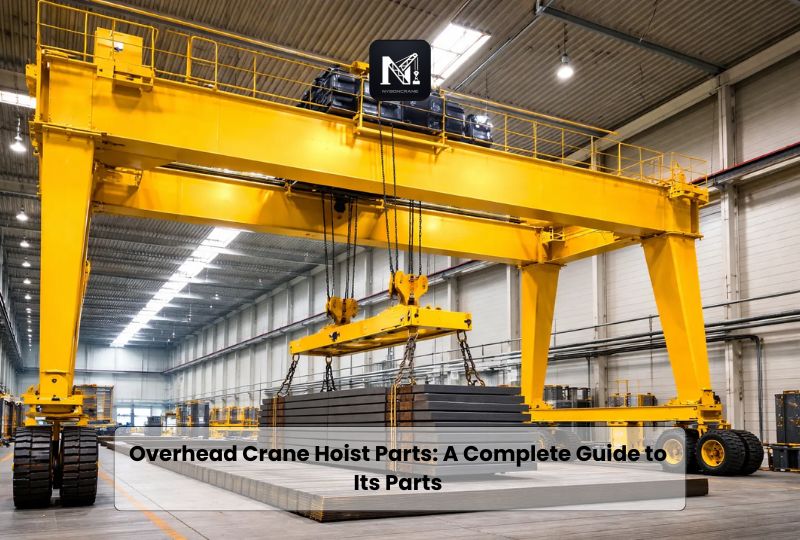
An overhead crane hoist is a small machine with a big job. It lifts, holds, and lowers heavy loads with precision, and it does this using a set of mechanical and electrical parts that work together as one system. Knowing what each part does helps buyers, maintenance teams, and operators choose the right hoist and keep it running safely.
This guide breaks down every major overhead crane hoist part, explains its role, and covers the key differences between wire rope and chain hoist components.
What Is an Overhead Crane Hoist?
A hoist is the lifting unit mounted on a crane’s trolley or bridge. It converts motor power into vertical movement, raising and lowering the load through a rope or chain. The hoist sits at the center of the crane’s lifting function, while the bridge, end trucks, and runway handle horizontal movement.
Most industrial hoists fall into two categories: wire rope hoists and chain hoists. Wire rope hoists handle heavier loads and longer duty cycles, while chain hoists suit lighter capacities and shorter lift heights. Both share several core parts, though their lifting mechanisms differ.
Core Overhead Crane Hoist Parts
Hoist Motor
The motor is the power source behind every lifting movement. It converts electrical energy into rotational force, which drives the drum or chain sprocket. Motor size is matched to the hoist’s rated capacity and duty class, since an undersized motor overheats under frequent use and a mismatched one wastes energy.
Gearbox (Speed Reducer)
The gearbox sits between the motor and the drum. It reduces the motor’s high rotational speed into a slower, more controlled lifting speed while multiplying torque. This gives the hoist the strength to lift heavy loads smoothly instead of jerking them upward.
Drum
Found in wire rope hoists, the drum is a grooved cylindrical part that winds and unwinds the wire rope during lifting and lowering. The grooves keep the rope aligned, prevent overlapping, and reduce wear from friction. Drum diameter is calculated based on rope diameter to avoid excessive bending stress.
Wire Rope or Load Chain
This is the component that physically connects the hook to the drum or sprocket. Wire rope hoists use multi-strand steel wire rope rated for specific breaking loads, while chain hoists use hardened steel link chain. Both require regular inspection for wear, kinks, broken strands, or stretched links, since this part carries the full load during every lift.
Hook and Hook Block
The hook attaches directly to the load and bears the entire lifting weight. Most industrial hooks are drop-forged steel with a safety latch to prevent accidental load slippage. The hook block houses the hook along with sheaves (for wire rope hoists) that guide the rope and reduce load on the rope itself.
Brake System
The brake holds the load in position once lifting stops and prevents free-fall in case of power loss. Most electric hoists use an electromagnetic brake that engages automatically when the motor is not powered. A well-maintained brake is one of the most critical safety components in any hoist.
Limit Switches
Limit switches automatically stop hoist movement at preset upper and lower positions. This prevents the hook block from over-traveling into the drum or the load from over-lowering. Many hoists also include limit switches for trolley and bridge travel to prevent end-of-track collisions.
Trolley
The trolley carries the hoist body and allows it to move along the bridge girder. Trolleys can be electric (motorized) or push type, and their wheels ride on the lower flange or top rail of the girder depending on the crane design.
Control System (Pendant, Remote, or Cabin)
The control system lets the operator manage lifting, lowering, and trolley movement. Pendant controls are the most common for standard hoists, while radio remote controls offer added mobility and safety by letting the operator step away from the load path.
Electrification and Festoon System
This includes the conductor bars, collectors, and festoon cables that supply power to the hoist motor and controls as the hoist and trolley move. A reliable electrification system prevents power interruptions during operation.
Overload Protection Device
This safety component monitors load weight and prevents lifting beyond the hoist’s rated capacity. It protects the motor, gearbox, and rope or chain from damage caused by overloading, which is one of the leading causes of premature hoist failure.
Bearings and Sheaves
Bearings support rotating parts like the drum and gearbox shafts, reducing friction and wear. Sheaves guide the wire rope through the hook block and, in some designs, the drum assembly. Both require periodic lubrication to maintain smooth operation.
Wire Rope Hoist Parts vs Chain Hoist Parts
The biggest difference lies in the lifting medium and its supporting hardware. Wire rope hoists rely on a drum, sheaves, and multi-strand rope, which suits higher capacities and taller lift heights. Chain hoists use a chain sprocket, load chain, and chain container instead of a drum, making them more compact and better suited to lighter, lower-duty applications.
For heavy industrial use, most manufacturers, including Nybon Machinery, build electric wire rope hoists as standard because they offer better load capacity, faster lifting speeds, and longer service life under continuous operation.
Signs of Hoist Part Wear or Failure
Regular inspection catches problems before they cause downtime or safety incidents. Watch for these warning signs:
- Frayed, kinked, or corroded wire rope
- Elongated or cracked chain links
- Unusual noise from the gearbox or motor
- Brake slippage or delayed engagement
- Limit switches that fail to stop movement at set points
- Oil leaks around the gearbox housing
Any of these issues should trigger immediate inspection by a qualified technician.
Standards Governing Hoist Parts
Hoist components used in China-manufactured cranes are typically designed and tested against GB/T 3811 for crane design rules and GB 6067 for safety requirements. Hoist duty classification follows the A1 to A8 duty class system, which determines how components like the motor, gearbox, and brake are rated for load spectrum and operating frequency. Buyers sourcing internationally should confirm which standard a manufacturer follows, since this affects component sizing and safety margins.
Frequently Asked Questions
What is the most important part of an overhead crane hoist?
The brake system is the most critical safety part, since it holds the load in place and prevents uncontrolled lowering if power is lost.
How often should hoist wire rope be inspected?
Wire rope should be inspected before each shift for visible damage and undergo a detailed inspection at least monthly, or more often under heavy-duty cycles.
Can chain hoist parts be replaced with wire rope hoist parts?
No, chain and wire rope hoists use different lifting mechanisms, and components are not interchangeable between the two systems.
What causes premature gearbox failure in hoists?
Overloading, poor lubrication, and continuous operation beyond the hoist’s rated duty class are the leading causes of gearbox failure.